Wednesday, January 23, 2013

Networked Personas, Catfish and Other Illusions


Manti Teo - (Photo by Mike Ehrmann/Getty Images)


"Your Catfish Friend" by Richard Brautigan

If I were to live my life
in catfish forms in scaffolds of skin and whiskers
at the bottom of a pond
and you were to come by
one evening when the moon was shining
down into my dark home
and stand there at the edge
of my affection and think, "It's beautiful
here by this pond. I wish
somebody loved me," I'd love you and be your catfish
friend and drive such lonely
thoughts from your mind
and suddenly you would be at peace, and ask yourself, "I wonder
if there are any catfish
in this pond? It seems like
a perfect place for them."


As Congreve said, “Heaven has no rage like love to hatred turned, Nor hell a fury like a woman scorned.” No rage is more pure than the rage of one who has been taken in and knows it. And when the woman scorned is a major media outlet, woe be unto the object of the fury.

The saga of Manti Teo, erstwhile Heisman contender from the University of Notre Dame, is not merely instructive. It fairly screams for sermonic adaptation. Here be dreams within dreams within dreams. We only thought Inception was fiction. Turns out it’s as true as true can be—or as true as anyone can weave a web of comfortably lovely untruths.

And to celebrate the achievement, we get to bandy a newly adapted word—from that most respectable of all bottom feeders, the catfish. The catfish is the new Eve of the Fallen Eden, the new Pandora of the celebrated Box, the new Jezebel to be thrown down from the window and torn apart by the dogs of public discourse.

The “new” term, which has evolved into the rarified advanced word-form of noun/verb, owes its origin to Nev and Ariel Shulman and their friend Henry Joost who created what is probably a faux-documentary, Catfish (2010), based on Nev’s “personal” experience. He “met” a person online and discovered over time that the person was faking parts of her networked identity. He decided to follow up anyway and plunge through the maze of conflicting messages to get to the bottom of who this person really was, though--given the nature of the film--all that is in doubt. Critics allege the film is too neatly packaged to be showing actual events. As a work, it may fall into the same genre as Exit Through the Gift Shop, another piece that mingles truth with dark irony to pack a message alongside an artistic prank (not quite as onerous as a hoax). Schulman has parlayed his work into an ongoing MTV series with the same name as his film that explores other incidents of “catfishing,” or being duped by a false online persona.

Another layer of irony is that the story about catfish and cod as told in the “documentary” is specious at best. As a boy living in the wetlands of southeast Virginia, I pulled my share of non-predatory catfish from muddy freshwater creeks. In a funny twist, the story may actually derive from a book of sermon illustrations. Regardless of the source, anyone who knows fish or fishing can tell you the story smells, well, you know. And this detail lends yet another touch of farcical comedy to the development of what is about to be a very common verb.

All recriminations aside, call this catfish Lenny Kekua in a fish story that grows more bizarre with the telling. If you don’t know the Manti Teo story, feel free to read it here.” Turns out the Lenny Kekua who died never actually lived, at least not in the flesh. Several major media outlets, including ESPN, were duped by the story that the star athlete was spending all his spare time on the phone with his dying love Lenny, all conveniently during the lead up to Heisman voting. It was a made-for-television drama that got made for television several times over by those who followed MT with great interest. MT apparently learned at some point that Lenny didn’t actually exist, that she was the creation of someone’s twisted imagination, that she was a special online plant who blossomed, lived a very short life and died a beautifully tragic death, all of which just happened to enhance and embellish the true-life story of the star athlete. Only it was all a lie. What we don’t know, and what is still unraveling, is how much and exactly when MT knew what we all know now.

Lars and the Real Girl
The story is a strange confluence of S1m0ne (’02) and Lars and the Real Girl (’07)—the one movie about a digitally manufactured actress pushed on the general public, the other about a desperately lonely man who is unaware that his girlfriend is a life-size doll.

Manti Teo, if he was truly duped (which many doubt) might be granted some slack here. Apparently the phenomenon of being “catfished” by a manufactured online persona isn’t that unusual. And it’s not as if the lines of personal identity haven’t already become blurred by technology anyway.

Who among us doesn’t want to be viewed in a positive light? We are all of us festooned with managed imagery every day, costuming ourselves for each role we play. Even the “genuine” among us who say they are declining to present a facade are, by their self-selection, presenting a carefully crafted image using loudly muted tones.

But the online Presence in which we are all granted an Avatar to stand in for our already altered selves takes the notion of image management to a whole new level. The gamey face I see in the mirror upon waking may be beautiful in the sight of God but is clearly unfit for Facebook. In fact, I can carefully control those bits and angles of me that people see. I can make of myself a sort of digital commodity and the people who constitute the audience for all of my socially networked connections (including  Twitter and Tumblr and Instagram and Pinterest and all the burgeoning legion of networking choices) create for me the illusion of a platform upon which I am perpetually posited. The imaginary crowd that “follows” me shares its love with comments, likes and favorites. If I am the rhetorical sort, I can scatter the seedlings of my thoughts upon the masses. If I am the emotionally needy sort, I can phish in any number of assorted ways for a cyberhug from my hundreds of besties. If I want to convert my audience of "friends" into a starter market for my wares, I need only self-advertise and create “pages” to be “liked” or "pinned" or whatever vapid new cyber-verb we introduce. It’s all about empowerment, right? And it has nothing at all to do with the marketing schemes of the people who were so obliging as to provide us with such platforms out of the sheer kindness of their hearts.

Are we all just a little catfishy? Are we all Lenny Kekua?

I don’t think so. At the risk of throwing the first stone, the ethical landscape has not really altered with the rise of all these new windows through which we can see and be seen. What has altered is the scope of opportunity, the target rich environment and the ridiculous ease with which one can deceive and be deceived. A lie by any other name is still a lie. And, as the high drama of the last couple of weeks has indicated, the fallout for a lie can be as radioactive as ever.

The moral, of course, is to have a care. Online environments are becoming increasingly accepting and even encouraging to catfish, many of whom believe they are just having a bit of fun. Anonymous pranskerism can be a heady rush for pimply geeks in their pajamas. But if we aren’t careful, this emerging brand of psychological vandalism may be the next common counseling concern as the victims line up for help.

Friday, January 18, 2013

Just a Spoonful of Torture: Zero Dark Thirty


One astonished recent reviewer for Les Miserables took care to warn people that the movie’s lines are all sung. “If you don’t know that going in, you might be surprised.”

I had a similar feeling for the movie Zero Dark Thirty. If you thought, as I did from the trailers, that this is the true-life Delta Force we’ve all been waiting for, only this time without Chuck Norris, then prepare to be very surprised.

Naturally I didn’t really think the film would be all about Seal Team Six. The actual raid on the Bin Laden compound is shot in real time for added authenticity, so there you go. What one might not expect is that the film delivers the decade-long “Hunt for Bin Laden” economically packed into the first two hours (and change). I don’t offer this as a problem, only as an observation.

Even as it receives accolades and major award nominations, Zero Dark Thirty is embroiled in controversy. Questions regarding depictions of torture, the film’s intent (is it propaganda?) and the unusual level of access to CIA and government figures by the scriptwriter have produced a veritable seething publicity pot for the release. Not surprisingly, Al Jazeera’s reviewers give the film credit for its own level of “collateral damage.”

Boal & Bigelow
The filmmakers are arguing fiercely for the fact-based objectivity of the film, trying to spin it as a neutral depiction of a true story with no political or otherwise hidden agenda. The problem, of course, is that artistic neutrality is a specious argument at best and a bald-faced lie at worst. Even documentaries are rhetorical; the very choice of subject matter is meant to draw our attention and enhance our awareness. The effect is always a subtle—or not so subtle—influence on consciousness that inevitably shades opinion and may possibly shape actual choices. While there is no hypodermic needle—stick the movie into your bloodstream and behave like an automaton—there is always some sort of positive or negative effect and a structure of new information upon which other information acts and reacts. There also may not be overt intentionality on the part of the filmmaker, but the framing of the story with its coded sympathies tends to privilege the reception and provides, if nothing else, a latticework of values under the surface.

Be that as it may, no great detective work is required to grasp the loyalties of this film. It begins with a powerful moment that I won’t spoil for anyone here. But the elements are clearly intended to re-kindle the cold furnace in the hearts and minds of citizens for whom 9/11 may have receded into distant memory. This is an undisguised and intentional setup to which the succeeding story elements cling with narrative fidelity.

Many critics have made much of the "misleading" faux-journalistic patina on the film, but anyone actually offended by such “truth” claims in a movie can only be marked down as naive. Don’t we all know by now that directors mesmerize themselves with the “truth” of their own art and care very little about everyone else’s misguided fetish for accuracy and fact? “Based on actual events” means just as much as “based on an idea by Fulano DeTal.” In other words, “Something did happen somewhere, but by the time I, the filmmaker, am finished with it, it’s going be a lot more compelling and interesting. You should be thanking me instead of condemning me.”

Along those lines, director Kathryn Bigelow and scriptwriter Mark Boal tap into some of the same strong narrative stuff that made The Hurt Locker so effective. They serve up a menu of sharply flavored fare, giving us tension, conflict and visceral action in carefully measured increments. I’m fully convinced that Bigelow and Boal are genuinely shocked by assertions that they are elevating torture as a viable means of information gathering. I really doubt they thought beyond the necessity of telling what a gritty and gut wrenching story. Torture for them was a means to a narrative end.

Jason Clarke as "Dan"
And that irony points up one of the central enigmas of this film. Jason Clarke as “Dan” delivers the same lines we are used to hearing from maniacal, leather-strapped villains as he goes about “breaking” detainees. Only he’s one of the good guys and he makes his threats without grinning through metal teeth. Later we see him clean-cut with white shirt and tie, the paragon of civilization itself, and somehow the paradox is washed away by the objective of killing Bin Laden. As an audience, we’ve been pushed toward justice mode, we believe the detainee is implicated somehow (he wouldn’t be a detainee if he wasn’t implicated, right?) that he and all the other conspirators deserve this treatment or worse. We want to think that the torture is justified. The payoff, that Bin Laden is bagged in the end, is the justification we require. It’s simple narrative arithmetic and therefore effective.

What most of the critics may not realize, or simply refuse to realize, is that a great many Americans who watch this film are going to have absolutely no problem with that arithmetic. None whatsoever. And it’s just as possible that Bigelow and Boal were counting on that. But who knows? Ultimately what this movie says, whether the makers intended it or not, is that you better not mess with the USofA because we have the wherewithal to get our revenge and we will persevere to the last full measure of our vengeance no matter how long it takes or how much frag damage we receive and/or inflict to get it done. So don’t start it.

The question is whether or not that clear message reduces the film to the level of propaganda. Bigelow and Boal are horrified by the thought, according to their interviews and the growing statements in their own defense. In fact, they feel very put upon by the accusation. They point their fingers (futilely) at a spirit of censorship and bluster that their artistic integrity is being called into question. I’m actually hoping they don’t win any Oscars because I cringe at the thought of the martyrdom they may feel obligated to pedal after all this.

So while this review is more about the controversy than the film, I should mention that it’s a good movie. Mark Boal is a good storyteller and Kathryn Bigelow is an innovative director. The impressive lineup of Brits and Aussies playing Americans lends gravitas even to the bit parts. (I’m always amazed and inspired by the work ethic of Commonwealth B-stars who labor so hard at little roles). Jennifer Ehle, Mark Strong, Jason Clarke and Joel Edgerton sketch their roles with strong outlines that lend credible definition to their characters.

Jessica Chastain as "Maya"
Jessica Chastain as the centerpiece of the film, Agent Maya, definitely delivers as the kid who came out of high school to hunt down the biggest bad guy in recent history. Thankfully the film does not resort to some sort of maudlin flashback to clue us in to the inspiration for the character's intense motivation. This leaves her to be Everyman and Everywoman Who Cares. And that may be a genuine description of the actual person upon whom her character is based. As a person with whom the audience is meant to identify, the choice clearly works.

Both the storyline and the “on-the-ground” filming afford us an efficient linearity that takes us from the Twin Towers to the compound in Pakistan where the 18 minutes of real-time raid provide a satisfying climax. At times the un-filmic verisimilitude felt a little like 1977’s Raid on Entebbe, a TV movie depicting the true-life story of Israeli commandos rescuing an airplane load of hostages in Angola. Only this time there was a singularly lethal purpose to the action. The tight dimensions of the story limit our view to a series of terrorist actions and undercover counter-terrorist operations, almost as though we are witnessing a deadly chess match where crucially important pieces are traded for advantage. The wider wars in the region are almost completely blocked from view, conveniently helping us to avoid any additional annoying ethical dilemmas.

One critic referred to ZDT as “the best movie you won’t have any fun watching.” It’s true that one does not leave the theatre with any sense of “Huzzah, America!” At the same time, the “enemy” is sufficiently dehumanized in this film and even the Pakistanis are so completely marginalized (referred to almost dismissively as “Paks”) that any sense of internal debate is quickly quelled. In the end, we get UBL, and that’s what matters. In the end, it’s all about catharsis for an America that is no longer the victim but the great Righter of Wrongs.

Sunday, December 30, 2012

At the End of the Day, It's a Good Movie: Les Misérables

-->

Note: This review contains a few plot spoilers near the end.

Oxford grad Tom Hooper is an exceptional director who has brought off some great stuff, mostly for television. His breakthrough directorial film effort was 2010’s extraordinary Oscar winning The King’s Speech, with Colin Firth in the role of George VI. He has also directed some very fine recent miniseries  (John Adams, Elizabeth I and Prime Suspect). His ability to create superior character pieces with a strong supporting cast in convincingly textured environments makes him one of the few complete directors who grasps the entire range of the work at hand.

Given Hooper's level of artistry, what wizardry can he bring to a legendary stage musical such as Les Misérables? Mind you, this is not one of those charming productions, alá Rogers and Hammerstein, where "normal" lines and acting are interrupted as the cast breaks into show stopping song and dance. Les Mis is one of the rare non-opera specimens featuring wall-to-wall music. It also just happens to be an iconic production that began in Paris, moved to London, crossed to Broadway, went back to the West End, then burst onto the world at large. Clearly Hooper faced a difficult challenge.

Stage aficionados should recognize immediately that the expectations for theatre and film diverge widely. There’s a level of energy and spontaneity on the stage that film can never achieve. The “frame” for theatre is the theatre itself, modified by set, sound and lighting. If you are one of the fortunates who caught a West End or Broadway showing of this particular production, then you have a pretty settled Holy Grail image in your mind and memory that probably no film is going to match. That, of course, doesn’t mean that a film version, with its potential to expand the visual scope and to capitalize on the acting, may not also be a solid work of art in its own right.

Fortunately Hooper played to his strengths in Les Misérables. He chose generally to direct the musical primarily as a film without trying to invoke the stage. Indications are that he resorted to live recording of the song track rather than canning it first or blending it in with post-production audio re-takes. Live piano played into singers’ earpieces and followed the pacing of the actor/singers, helping them hit the notes. The orchestral music was edited in afterwards and was also tailored to the performances. This method freed the actors to “act” as they sang. Hooper’s direction is nearly impeccable here and the actual performances are so convincing that technically imperfect singing comes across as somehow "right."  Particularly moving are the performances by Jackman, Hathaway, Samantha Barks (Eponine) and the astonishingly good Eddie Redmayne (Marius).

While Amanda Seyfried does justice to the role of Cosette, she had the misfortune of landing the most poorly developed part in the production—a classic ingénue of the worst kind. It’s really hard not to root for Eponine at Cosette’s expense. But maybe that’s what we’re supposed to do.

Hooper made use of many West End regulars to fill in the extras on the cast (Barks is the only headliner taken from the stage production). Most notably, Colm Wilkinson, the original Jean Valjean, makes an appearance as the priest.  Naturally, many believe his version of “Bring Him Home” is definitive. Perhaps it is. Judge for yourself in this clip from an anniversary concert.

The standout for worst performance, as many feared, is Russell Crowe as Javert. (One wonders what Hugo Weaving, Gary Oldman and Ralph Fiennes were up to). Rumor has it that Paul Bettany was considered for the part. While it's hard to see Bettany in the role, he would probably have been better than the plodding, unresponsive Crowe who looked to be concentrating too hard on his earpiece and forgetting he was supposed to act. Classic depictions of the darkly neurotic and obsessive inspector are shot to pieces by Crowe’s beefy attempt at pathos.

As a film, Hooper’s version contains some great moments, especially in the first act when we’re treated to wonderful French scenery. After that, things begin to move steadily toward contained locations, though the scene selection is generally strong with brilliant attention to symbolic detail. This strength was wasted a little by the overuse of close-ups during many of the key numbers. While the tight camera brought out emotive aspects of the music on a previously untapped level, it could just as easily have helped tell the “story” in these songs with just a little more shot variety. As a for instance, a few more angles were used to wonderful effect in Marius’ “Empty Chairs and Empty Tables,” and might easily have been employed with some of the other songs in which the close-up was the primary vehicle. At the opposite extreme, Sacha Baron Cohen and Helena Bonham Carter with her tossed salad coiffure were almost drowned by their  scenes. Each time the running gag villains get screen time, they seem to be inundated by their environs. As creative choices maybe these were the right ones, but they leave room for doubt.

At the barricade
Given the cinematographic qualities elsewhere in the film, the claustrophobic barricade set looked suspiciously stage-like, even with some of the lighting. The original cast of hundreds shrank to the handful one might see on stage as well. Perhaps Hooper wanted to achieve a theatrical homage as well as convey the hopelessness of the student heroes of the June Rebellion. While the set did not take full advantage of the film medium, the approach may have achieved a certain level of dramatic tension that served to heighten the final tragic moments of the handsome young intellectuals, at least one great moment in the movie impossible for the stage to match.

A flaw in the original that carried to the film is the inexplicable rapid aging of Jean Valjean between the close of the rebellion and the marriage of Marius and Cosette.  It has the effect of rushing to bring things to a close. You would think Hooper might come up with a convenient time device to create better continuity, but no; he let it go, too. 

I regret to have to mention the finale. If you haven't seen the film, read no further. The finale especially plays up the difference between the stage and screen. I wanted that swelling moment that polished off the production for me at the Queen’s Theatre in London back in 2005. The film moment just didn’t quite get there and it left me feeling a little unfulfilled.

In summary, Hooper turns out a terrific and in some places daring piece of work studded with many wonderful individual performances. It may not be the incredible film people were hoping for, but it’s definitely a great viewing experience worth catching at the theatre rather than waiting for the DVD. Give it four out of five of your preferred emoji.

Friday, December 21, 2012

Taking the Unexpected Journey: The Hobbit

I’ll never forget when I first met Bilbo Baggins. It was the mid-70s, I was thirteen years old and my classmates and I were reading from an Open Court classics anthology. One of the stories was a bizarre but gripping tale called “Riddles in the Dark.” Few things I have read have seized my imagination so completely and irrevocably. Instantly I wanted to know more about this story and more about its author with the funny name, JRR Tolkien.

At my first opportunity to get to a library, I found hardbound copies of The Lord of the Rings. I don’t recall whether The Hobbit was unavailable or what exactly prompted me, but I began reading The Fellowship of the Ring and, before I knew it, I was lost in Middle Earth. I didn’t end up reading The Hobbit until I was finished with LOTR. Only then did I realize my mistake. It was enormously difficult for me to appreciate the childish tone and style of The Hobbit after having been seduced by the grand and heroic style of LOTR.

Perhaps Peter Jackson suffered from a similar problem. Early reports were that he did not originally plan to attempt The Hobbit. Surely he was just exhausted after filming the Tolkienic epic that took so many years and so many nearly sleepless nights. Be that as it may, he did finally decide to take The Hobbit along the same filmic journey as the other books. Initial rumors had Pan's Labyrinth's Guillermo Del Toro directing. It would have been a wonderful thing, but it was not to be. In the end, Jackson came back to complete his work. The single film quickly expanded to two, then to three movies. Thus the filmic body of work, when it’s all done, will be about 24 hours long. That much Tolkien is a little hard not to get all geeked up about.

This review comes after The Hobbit movie has been out for a week and I have had the chance to see it twice in 2D and at the lower frame rate. So if you are looking for comment on the 3D or 48 fps versions, or to hear another take on the great frame rate debate, I’m sorry to disappoint.

At the outset I want to say that I was centrally interested in the “Riddles” portion of the film, primarily for nostalgic reasons, and was willing to tolerate a good deal of Jacksonian silliness so long as he got that scene right.

The good news is that he did get it right, at least in my estimation. I found myself luxuriating in the unhurried length of the scene. Martin Freeman and Andy Serkis (who richly deserves some kind of Oscar nod) were spot on. The touch of dramatic foreshadowing with Gollum's split personality adds humor and dimensionality. When the scene concluded, I uttered a contented sigh and, like the Divine surveying Creation, saw that it was good.

As for the rest of the film, I have read the negative reviews. Most agree on the Bilbo-Gollum duet. But many reviewers take issue with the film’s pacing, with the additions to the book from other parts of the Tolkien opus, with the sometimes ham-fisted CGI and with the scenes that have a theme park, roller-coaster feel and with the perceived focus on Thorin Oakenshield. Some decry the conversion of a happy little book into a “plodding epic.”

As for me, I have certainly coughed hairballs over Peter Jackson’s bloated graphic-action fare. In the Fellowship, I was aggrieved to watch the gripping scene in the Mines of Moria converted into a rocky trapeze act. Nevertheless, enough was preserved and enough brilliance added, particularly in the immortal “You shall not pass!” line on the bridge of Khazad-dum, that the overall effect teetered toward the positive side.

The Two Towers, on the other hand, contains a large helping of unforgivable tripe. I have expounded elsewhere on the many travesties and the true violence I feel Jackson did to the middle part of the trilogy. This was redeemed somewhat by the March of the Ents, a magnificent filmic moment that gives me chills every time I see it. But in the Return, Jackson continued his absurdities with the laughable signal fires on ridiculously impossible peaks, culminating in the Circus of Pelennor Fields, another one of those scenes beautifully fixed in my mind from the novel and brutalized by Jackson’s super-hero gymnastics and off-the-scale FX.

Given the good, the bad and the ugly of the first three films, it’s a little difficult to comprehend how current reviewers, who appear to be amnesiacs, are eager to flog The Hobbit for flaws that troubled the first three films as if this one suffers somehow in comparison. Perhaps Elijah Wood’s dreamy blue eyes mesmerized them. The greatest blemishes in all of these movies can be traced directly to the bombastic flourishes in Jackson’s directorial and visual style. The truth is that one has to take them or leave them. There really seems little point anymore in belaboring them.

With regard to extra material, we knew once we heard that the more or less linear tale in The Hobbit was going to get a three-part treatment that Jackson and his team would dip into the “extras” of Tolkien’s larger story. While some see these elements, such as the expanded role of Radagast the Brown, as distracting, these added elements might just make the story more coherent as a prequel to LOTR. To be fair, the bare bones children’s story that sprang originally from Tolkien’s imagination was scarcely a fit vessel to contain the seeds of the Ring of Power story. Ironically, the Ring is too big for the smaller tale, and to keep that tale so small, while it might have done fitting homage to the original story, would not have done justice to the larger work. We are willing to agree with Jackson on the need to enlarge the scope of the story.

The grousing about the film’s pacing and focus puzzles me. Once again, if we are comparing this film to The Fellowship, for instance, Hobbit surely comes out ahead on both of those? Of course, now that we have the expanded versions of the other movies, complete with all the DVD add-on treasures, talk about pacing may be entirely irrelevant. One wonders how another hour added to this film could possibly be a good thing.

What is wrong with this movie? Basically the same things are wrong with this film as are wrong with the earlier films - with a bonus unconvincing villain. One understands Jackson’s need for a more robust bad guy in the absence of the All-Seeing Eye. But the Pale Orc Azog, while he might have been a good thought, doesn't measure up. Had he been a ranging Maori with fantastic prosthetics like the Uruk Hai chieftain in Fellowship, things might have gone much better. But one has to admit that Jackson’s lame attempt to pull a Jessica Rabbit out of his hat with a poorly executed animated brute is possibly the film’s greatest disappointment.

In balance, Hobbit rates on my scale as almost equal to Fellowship of the Ring, the best of the earlier trilogy. Even with the animated villains (count in the goblin king as well), the crazy rock-em, sock-em stone giants and the Disney-ride escape scenes, the overall quality came across as a step beyond the previous films and the story combined enough light and dark to give the plot a richer texture. Finally, add to the balance the superior acting performances in this film. Martin Freeman and Andy Serkis are truly remarkable. Ian McKellan is obviously having the time of his life. And the dwarves, notably Richard Armitage as Thorin and Ken Stott as Balin, are simply terrific. Aiden Turner as Kili is, of course, more of a video game elf than a dwarf, but we’ll turn a blind eye to that one in the interest of holiday generosity.

Four stars out of five: Don’t let the trolls keep you away.

Friday, October 07, 2011

The Book of Jobs


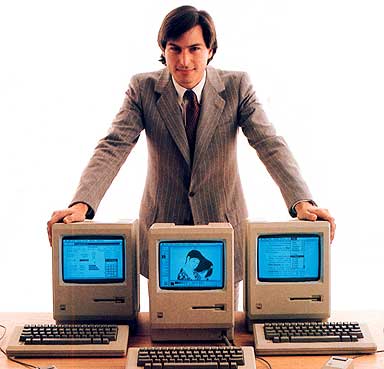
I remember the first Apple Macintosh I ever saw. It was in 1985, just a year after the first models (named for the McIntosh apple) came out. I had used a few PCs before that. But sitting down to a Mac 512k, that awkward box with its tiny screen, opened a whole new world. I spent hours upon hours playing with the new graphics software--MacPaint especially. Then I got hold of Aldus Pagemaker, taught myself desktop publishing and, without knowing it at the time, changed the course of my life.

When it came time to buy a personal computer a couple of years later, I couldn't afford a Mac. This was the most common complaint about Apple at the time. But I couldn't go back to PC, so I went with the Commodore Amiga because it had moved in the direction of innovation, like Apple, and the Amiga was a hot item in the graphics world for the brief, shiny years of its success.

Well, as the computing gods would have it, that Amiga became a glorified word processor that helped me churn out all those grad school papers. But I found a home in the tiny, mostly unsupported and unknown Mac lab at school as I moved into journalism and became a magazine editor. I got the job because I was only one of a handful of people around who could do desktop publishing. With legions of homegrown digital designers under every rock these days, it seems hard to imagine that I was among a select few a mere 20 years ago.

Upon graduation with my degrees in rhetoric and journalism, I got my first college teaching job and bought a Mac Performa, a monster of a machine around which much of my professional and creative life would evolve for several years. When I came to Lee University in 1995, I helped inaugurate the first Mac lab in Student Publications--three lonely Power Macs on an otherwise entirely PC campus. Now, 15 years later, you can't walk ten feet in any direction around here without bumping into someone with an Apple product.

During those years, I knew little or nothing about Steve Jobs or his saga. In fact, I had become convinced that the Mac could go the way of the Amiga any day--a thought that filled me with sadness. I did not merely like Mac as a brand (that dogged irrational loyalty!), I preferred it as a platform that suited my creative and professional needs, and, yes, my personality. It was hard to explain any of this to my many PC friends who were utterly convinced that a PC could do anything I needed more cheaply and efficiently and, besides that, provide a near unlimited platform for games, even if you had to replace your cheap PC or parts with enough regularity to have paid for a Mac by the time you were done.

In time, I have watched as nearly all my PC friends who once jeered at Apple have acquired IPhones and IPads and, even Mac laptops before I have had the chance to get the latest devices. My PC fans still love their PCs, they just ... don't spend as much time on them as they used to. The flexibility and sheer "coolness" of Apple products finally persuaded them when my shrill evangelism failed.

And while this amazing transformation was taking place, Pixar was creating the best animated features available, other Jobs ideas were integrating with all the latest and greatest technologies, and countless other innovations like IPod and ITunes were taking the world by storm. Yes, Microsoft reigns supreme, like the Emperor in his Death Star, thanks in part to well-known "borrowing" of key Apple ideas long ago. But now, after just a couple of decades, Apple isn't merely a brand, it's a philosophic meme.

All this is because a college dropout named Steve Jobs decided to do what he loved--and to make what he did the best he could possibly make it.

Ayn Rand's myth of the Individual is an elaborate, wistful fraud. But the power of one person to create, and by creating to craft a lever to shift the world, is supported by cases like Steve Jobs'. It's humbling to ponder the extent to which so many of us are indebted to a man whom we will never meet. My own power to create today is, in part, a direct product of his.

Thanks, Steve. We cannot predict how much we will miss you, only that we certainly will.

Here's to the Crazy Ones

Friday, February 25, 2011

Movies: Reel Truth or Graven Image?

(Presented in Dixon Center Chapel, February 24, 2011)

The 83rd Annual Academy Awards are set to come off in style this weekend. I’m not inclined to advertise the show, as I typically find it agonizingly dull. I understand that there’s an I-Pad and I-Phone app you can download to follow every second of the event even through commercials, so if you’re a fan, go ahead and knock yourself out. I used to be really interested in who was going to win what, but after years of disappointment in both the ceremony and the results of the ceremony, I’m sorry to say my interest has begun to flag. It’s hard, though, not to feel a little curiosity about whether The King’s Speech or The Social Network or Inception will get Best Picture, so I might suffer through it anyway.

Of equal interest are the Golden Raspberry Awards, also this weekend, where the worst in the year’s films also receive the recognition they richly deserve. I hear the latest Twilight film is one of the nominees, though it’s hard for me to be objective as I suffered a kidney stone about halfway through it. I’m not at all sure the movie didn't cause the kidney stone. I'm actually afraid to try to finish it.

So, as you now know, today’s topic is movies. I’d like to address a question that tends to make people uncomfortable—What role to do the movies play in the life of a Christian? And, perhaps more importantly, is there a RIGHT way to think about movies?

I should provide a disclaimer at this point. By talking about movies at all I am guaranteed to disappoint, anger, offend or otherwise provoke just about every person in the audience today. If I fail to do that, then it’s highly likely I will have been of no use whatsoever.


First for some background: In 1973, when I was eleven years old, my family did two things that would change the course of my life. We sold our television and we stopped watching theatrical films. The last TV show I remember watching in those days was the pilot for “Little House on the Prairie.” The last film I can recall was a terrible Disney thing called, The World’s Greatest Athlete. It was really horrible. Considering the fact that I wouldn’t watch another theatrical release for twelve years, it was a decidedly bad way to end. I didn’t own a TV set for the next 15 years.

Some people would applaud such a drastic move away from the eye candy of the world, the flesh and the devil. And I have to admit that from one standpoint, it was the best thing that ever happened to me. Freedom from mainstream visual media allowed me to focus on books, newspapers and radio for a decade and a half. I should mention that newspapers and radio were contraband. The strict religious community to which my family belonged at the time forbade both, but my father ignored the newspaper ban (thanks, Dad!) and I ignored the radio ban, listening to National Public Radio every chance I got, along with weekend sports. I never saw the Super Bowl all those years, but I could have recited you a mean play-by-play.

When it came to books, I read several each week. I generally didn’t tell people what I was reading because if you did that in our particular religious community, you fell under dark suspicion of heretical and unholy leanings that you caught, like a disease, from the paper on the pages. The book might be yanked and you might be placed “on restriction,” which meant an indefinite period of penance marked by silence, fasting, heavy Bible reading and lengthy essays confessing the error of your ways.


But in spite of all the good things that came from my decade and a half hiatus from visual mass media, I was pretty unhappy about it at the time. I would have preferred to be John J.B. Wilson, founder of the Raspberry Awards who also wrote a funny book called Everything I Know I Learned From the Movies: A Compilation of Clichés and Un-Truisms Gleaned from a Lifetime Spent Entirely Too Much in the Dark. (As a side note here, last year, Sandra Bullock was the first person to win a Razzie and an Oscar in the same year. She also showed up for both ceremonies.)

Before we go any further, allow me to set your mind at ease. I love movies. Growing up in the strictest of religious sects produced in me a spirit of such towering rebellion that I went forth and became a media specialist and I have immersed myself for the past thirty years in virtually every form of mass media imaginable, from pamphlets to smart phones. I spend more hours on Netflix every week than I care to confess to this group. Most of you aren’t even my Facebook friends, so how can I trust you with such private information?

Let’s begin the discussion with one of my favorite false analogies. Maybe you’ve heard the inspirational parable about the wise father and the brownies. It can be found here, but I'll read it to you:


"A father of some teenage children had the family rule that they could not attend PG-13 or R rated movies. His three teens wanted to see a particular popular movie that was playing at local theaters. It was rated PG-13. The teens interviewed friends and even some members of their family's church to find out what was offensive in the movie. The teens made a list of pros and cons about the movie to use to convince their dad that they should be allowed to see it. The con's were that it contained ONLY 3 swear words, the ONLY violence was a building exploding (and you see that on TV all the time they said), and you actually did not "see" the couple in the movie having sex - it was just implied sex, off camera. The pros were that it was a popular movie - a blockbuster. Everyone was seeing it. If the teens saw the movie then they would not feel left out when their friends discussed it. The movie contained a good story and plot. It had some great adventure and suspense in it. There were some fantastic special effects in this movie. The movie's stars were some of the most talented actors in Hollywood. It probably would be nominated for several awards. Many of the members of their Christian church had even seen the movie and said it wasn't "very bad". Therefore, since there were more pros than cons the teens said they were asking their father to reconsider his position on just this ONE movie and let them have permission to go see it. The father looked at the list and thought for a few minutes. He said he could tell his children had spent some time and thought on this request. He asked if he could have a day to think about it before making his decision. The teens were thrilled thinking; "Now we've got him! Our argument is too good! Dad can't turn us down!" So, they happily agreed to let him have a day to think about their request. The next evening the father called in his three teenagers, who were smiling smugly, into the living room. There on the coffee table he had a plate of brownies. The teens were puzzled. The father told his children he had thought about their request and had decided that if they would eat a brownie then he would let them go to the movie. But just like the movie, the brownies had pros and cons. The pros were that they were made with the finest chocolate and other good ingredients. They had the added special effect of yummy walnuts in them. The brownies were moist and fresh with wonderful chocolate frosting on top. He had made these fantastic brownies using an award-winning recipe. And best of all, the brownies had been made lovingly by the hand of their own father. The brownies only had one con. The father had included a little bit of a special ingredient. The brownies also contained just a little bit of dog poop. But he had mixed the dough well - they probably would not even be able to taste the dog poop and he had baked it at 350 degrees so any bacteria or germs from the dog poop had probably been destroyed. Therefore, if any of his children could stand to eat the brownies which included just a "little bit of crap" and not be effected by it, then he knew they would also be able to see the movie with "just a little bit of smut" and not be effected. Of course, none of the teens would eat the brownies and the smug smiles had left their faces. Only Dad was smiling smugly as they left the room. Now when his teenagers ask permission to do something he is opposed to the father just asks, "Would you like me to whip up a batch of my special brownies?"

I thought you would like that story. The problem with a false analogy is that it forces your perspective to the range of choices before you. It does not ask first just how alike or unlike the two things are that are being paired. For example, here’s a great false analogy: “Employees are like nails. Just as nails must be hit on the head, so must employees be hit on the head.” In the brownie analogy, we find ourselves wondering whether or not consuming brownies and watching movies are sufficiently alike to draw the likeness between them. Then we have to ask whether the presence of fecal matter and the incidence of vulgarities are also enough alike to make the analogy hold up. If you think eating a nutty, chocolaty brownie and sitting down to a romantic comedy fall into the same general category of pleasure inducing excitement, then for you this analogy is pretty tight and you should therefore avoid any filmic work that has anything in it that might represent dog poop in your fragile consciousness.

We all know that when you start talking about Christians and movies, you cannot be too careful. The opinions on what is wise and what is permissible are as varied as they are vehement. On one side you have this father with his brownies who believes that the 13 in PG 13 movies is a pinch of arsenic in the mocha latte of life. “Touch not the unclean thing!” But clear on the other side you have people, like some Christian pop culture experts I could name, who say that those who are offended when they watch explicit material are weaker brethren. Since all good things come from God, we should strive to see the good in filmic art and celebrate it. We should be willing, like Jesus, to sit down and eat with the publicans and sinners. How else can we be salt and light in a fallen world, how else can we be faithful witnesses shining a light in the darkness?

Guess what? I’m not going to presume to dictate to anyone today just who is right or wrong in this wide ranging debate about Christians and film. What I can tell you, from having good friends on opposite ends of the spectrum, is that the trench lines in this debate are deeply dug and firmly fixed and the culture warriors manning those trenches are more than eager to lob holy hand grenades at each other across the no man’s land of Hollywood. And while I’m certainly one of those warriors, I have no doubt at all that if I were to attempt to impose my personal standards on anyone here today, I might as well have showed up in a Darth Vader costume (a small one).

So what do I have to offer today that might be of any use in this discussion? What can I toss out there that might provide some sort of plumb line for the faithful?


I’d like to offer today not so much a definitive standard for judging films as a framework for helping people make good decisions about them. People who know of my interest in film are quick to ask me what I think about certain movies. Usually the conversation goes something like this: “Dr. Melton, have you seen Death to Smoochy?” “No, I can’t say that I have.” “Dude! You haven’t seen it? You really need to see it.” “Really?” “Yeah—you gotta watch it and then tell me what you think of it” “Is it any good?” “Yeah! It’s the best movie I’ve ever seen.” “Wow! Okay then, I’ll check it out.” I then go and find Death to Smoochy and watch it. I’m horrified. It’s like scraping my eyeballs with razorblades or squeezing my brains out through my ears like Play Doh. Later, “Did you watch it yet?” “Yes, I did.” “What did you think?” “It … wasn’t … really my thing.” “You mean you didn’t like it? How is that possible? How could you not love this movie?” “Well, to be honest, I hated it.” And they go their way sorrowing.

I’ve had this conversation any number of times and if nothing else, these encounters about film point out just how subjective appreciation of the film art can be. But is that the end of it? Do we settle for endless subjectivity? Is that the answer when it comes to the Christian and film? Or is there a better way?

I think there is. I want to give you something today that I hope will change the way you look at the movies. I hope you take what I offer in the spirit of good faith and apply it to the movies you watch. I’m not naïve enough to think that these ideas are going to bring a sudden unity of feeling with regard to movie appreciation—but I hope it will get us talking on more meaningful terms.

When we watch a movie, we generally get a sense of whether we like it or not. Sometimes the impression is so favorable we’re ready to hang out a banner and declare to all the world, no matter what anyone else feels, that this film is awesome and worthy of worship. We might face ridicule, verbal abuse and mockery, but we sometimes consider it a badge of honor to like movies no one else seems to like.

Here’s the question I’d like for you to ask of your favorite film—what if the universe of that movie were the real universe? No, I’m not getting all mystical and fantastical. I’m just trying to provide a way to read some of the virtues of the piece of art. What if the universe of the film were the real universe? What kind of world would we be living in? Most importantly, what is sacred in this alternative world, not just in plot and dialog, but also in the way the film unfolds, in the camera work, in compositional hierarchies, in all the various ways that a film presents the imagery, the colors, the sound, the music, the action, the characters? All these things are part of the universe of the film and they can speak quite loudly when you stop long enough to listen. It’s not just about the story and it’s not just about the so-called message.


Let’s take an example. In last year’s mega blockbuster Avatar by the same James Cameron who brought us Titanic in 1997 (“I’m king of the world!”), we are transported to an alien landscape and treated, via the miracle of computer animation, to exotic life forms of breathtaking scope and beauty. Somewhere in there we are treated to a plot that pits a destructively evil mining corporation against native plants and innocent life forms.

It doesn’t take a 3D viewing of this movie to recognize that the most important element, the most sacred part of the text, is not the plot or the message or any particular character—it’s the lovingly created world of Pandora. At every turn, the camera leads us to the astonishing color, beauty and even danger of this exotic place. It’s almost an imaginary National Geographic documentary that just happens to have an adventure story clinging to it.


As such, while some Christians dismissed the film as mystical mumbo jumbo, I think some missed a terrific opportunity to allow this movie to inspire love and appreciation of our own world, of the breathtaking beauty and attention to detail provided by our own Creator, of the endless variety of earth-bound blessings we enjoy every day in our sunrises and sunsets, and ultimately of the sacredness of life.

Am I saying everything about this movie is wonderful? Of course not. I am, after all, a critic, and I wrote a review of this film shortly after its release in which I shared a fuller slate of issues, but I only wanted to use it to make a point.


Let’s look at another “artistic” film of recent memory. Take 300, the movie based on Frank Miller’s graphic novel. Like Avatar, 300 is heavy on the graphics side, filmed almost entirely indoors in front of green screens, much like “Blues Clues.” But what is elevated by the art in this film? Besides digitally enhanced six-pack abs, red capes and speedos, the art of this film is devoted to making mayhem visually appealing to the tune of driving rock music. A near endless sequence of shots with creative variable speeds are affectionately dedicated to the dismembering, decapitating and otherwise dispatching of staggering numbers of people in various states of costumed splendor. Yes, there is an underlying message about courage and sacrifice—not to mention beefcake—but in the universe of the movie, the filmmakers telegraph for us the focal point of the energy and passion in their art.

Now here is where I am likely to offend you, if you are not already offended. As Christians and as sub-creators, certainly we can admire slick graphics, superior technique and glittering production values of a film like 300. But how far do we embrace the piety of the art, how much do we allow ourselves to identify with that which a film elevates as sacred? Should a Christian allow himself or herself to be seduced into finding mayhem beautiful? I certainly hope not. And right now I’m being psychically bombarded by a lot of “but, Dr. Melton.” Let me move on.


Let’s talk about message vs means. In some film art you have Good Message delivered with Terrible Means—one thinks of the Left Behind movies here. The underlying theme in such art is that God doesn’t care about production values. Schlock with a good message is still good and should not be spoken evil of. I beg to differ and I think most you would agree. Our Creator has the most awesome production values anyone could ask for. Isn’t shabby work an insult?

But beyond cheesy production values is a spate of films that receive a fair amount of support among Christian viewers because of what is seen as their redeeming message. I’m talking about movies like The Boondock Saints, Pulp Fiction, V for Vendetta, the Saw series. The list goes on. Now we’re getting serous. I see many of these on favorite film lists on Facebook and it always surprises me, but I suppose it shouldn’t.


All I can say is that, as I’ve said before, we need to take the step of considering what the actual working of the film elevates as sacred. In Boondock Saints, for instance, a triune gun-crew of studdly Irish Americans execute bad guys in highly stylized vigilante fashion. The movie fits into a genre of neo-gangland films that combine quirky scripts, unconventional filming and artsy pacing to deliver action-packed, pulse-pounding, hard-driving stories with more violence per second than chocolate chips per bite in something from the Cookie Store. Violence in a film is not bad per se, as in HBO’s recent series The Pacific that tells the unvarnished story of American Marines in World War II. But when the violence is elevated to the sacred, when it appears for its own sake to appeal to baser instincts, which it does in some of the films I’ve mentioned, we have a problem.

In the Saw movies, for instance, the message is certainly that your sins will find you out. But they will also chain you in a little room and dismember you digit by digit. Or drown you in a glass box. Or some other terrible fate. Are you getting the picture here?


What about a film that uses Good Means to convey a Terrible Message—the technique is cool but the film preaches bad values? Certainly some of the movies mentioned above also fit into that category, but we often find ourselves being manipulated into cheering for criminals. The Oceans Eleven movies, for instance, do an exceptional job with this. In the old days, the so-called Code did not allow criminals to get away with their villainy. The original 1960 version of Oceans Eleven, abiding by this code, makes use of a wonderfully creative ending to bring the work of the thieves to naught. We seem to have few such compulsions today.


On occasion you get a Good Message and Good Means together, though the old Hollywood adage is as true now as it ever was—if you want to send a message, use Western Union (though we might say Facebook today). Film art that focuses primarily on message tends to get derailed as art. What you want is a great story with solid entertainment credit that elevates as sacred something of genuine redeeming value. New films that fit the All Good category, in my view, would be The King’s Speech, True Grit and Toy Story 3. I could list more, but I’m running short on time.

Allow me to conclude with this thought. Before you stick a film on your lapel or wear it proudly like an article of clothing, please stop and consider what I’ve said today. I’m not charging us to ask ourselves what movies would Jesus watch. Those who say we should hang out with the publicans and sinners at the movie house actually have a point. In John 17 Jesus prays that we would remain in the world but be not of it—that means, I believe, that we are to fully engage our culture. In another sense, as Tolkien said in his essay “On Faerie Stories,” we are creative beings. We have been given these art forms. We should use them and appreciate their beauty when it’s appropriate to do.

I don’t think for a minute that many people in this room will necessarily agree with my conclusions, but if I have made you just a little uncomfortable, if I have made you think, if I have made you stop and consider the piety of an individual movie, if, in short, I have ruined your film viewing experience and made you attempt to fit the films you enjoy into the larger framework of your life as a Christian, then, to quote a famous Star Wars character, “Everthing is going according to plan. Mwahahahaha!”


If you'd like to listen to the podcast, you can find it here.