Friday, October 07, 2011

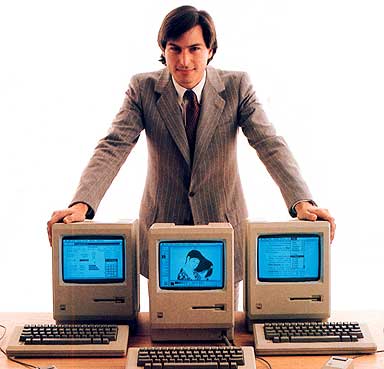
The Book of Jobs


I remember the first Apple Macintosh I ever saw. It was in 1985, just a year after the first models (named for the McIntosh apple) came out. I had used a few PCs before that. But sitting down to a Mac 512k, that awkward box with its tiny screen, opened a whole new world. I spent hours upon hours playing with the new graphics software--MacPaint especially. Then I got hold of Aldus Pagemaker, taught myself desktop publishing and, without knowing it at the time, changed the course of my life.

When it came time to buy a personal computer a couple of years later, I couldn't afford a Mac. This was the most common complaint about Apple at the time. But I couldn't go back to PC, so I went with the Commodore Amiga because it had moved in the direction of innovation, like Apple, and the Amiga was a hot item in the graphics world for the brief, shiny years of its success.

Well, as the computing gods would have it, that Amiga became a glorified word processor that helped me churn out all those grad school papers. But I found a home in the tiny, mostly unsupported and unknown Mac lab at school as I moved into journalism and became a magazine editor. I got the job because I was only one of a handful of people around who could do desktop publishing. With legions of homegrown digital designers under every rock these days, it seems hard to imagine that I was among a select few a mere 20 years ago.

Upon graduation with my degrees in rhetoric and journalism, I got my first college teaching job and bought a Mac Performa, a monster of a machine around which much of my professional and creative life would evolve for several years. When I came to Lee University in 1995, I helped inaugurate the first Mac lab in Student Publications--three lonely Power Macs on an otherwise entirely PC campus. Now, 15 years later, you can't walk ten feet in any direction around here without bumping into someone with an Apple product.

During those years, I knew little or nothing about Steve Jobs or his saga. In fact, I had become convinced that the Mac could go the way of the Amiga any day--a thought that filled me with sadness. I did not merely like Mac as a brand (that dogged irrational loyalty!), I preferred it as a platform that suited my creative and professional needs, and, yes, my personality. It was hard to explain any of this to my many PC friends who were utterly convinced that a PC could do anything I needed more cheaply and efficiently and, besides that, provide a near unlimited platform for games, even if you had to replace your cheap PC or parts with enough regularity to have paid for a Mac by the time you were done.

In time, I have watched as nearly all my PC friends who once jeered at Apple have acquired IPhones and IPads and, even Mac laptops before I have had the chance to get the latest devices. My PC fans still love their PCs, they just ... don't spend as much time on them as they used to. The flexibility and sheer "coolness" of Apple products finally persuaded them when my shrill evangelism failed.

And while this amazing transformation was taking place, Pixar was creating the best animated features available, other Jobs ideas were integrating with all the latest and greatest technologies, and countless other innovations like IPod and ITunes were taking the world by storm. Yes, Microsoft reigns supreme, like the Emperor in his Death Star, thanks in part to well-known "borrowing" of key Apple ideas long ago. But now, after just a couple of decades, Apple isn't merely a brand, it's a philosophic meme.

All this is because a college dropout named Steve Jobs decided to do what he loved--and to make what he did the best he could possibly make it.

Ayn Rand's myth of the Individual is an elaborate, wistful fraud. But the power of one person to create, and by creating to craft a lever to shift the world, is supported by cases like Steve Jobs'. It's humbling to ponder the extent to which so many of us are indebted to a man whom we will never meet. My own power to create today is, in part, a direct product of his.

Thanks, Steve. We cannot predict how much we will miss you, only that we certainly will.

Here's to the Crazy Ones

Friday, February 25, 2011

Movies: Reel Truth or Graven Image?

(Presented in Dixon Center Chapel, February 24, 2011)

The 83rd Annual Academy Awards are set to come off in style this weekend. I’m not inclined to advertise the show, as I typically find it agonizingly dull. I understand that there’s an I-Pad and I-Phone app you can download to follow every second of the event even through commercials, so if you’re a fan, go ahead and knock yourself out. I used to be really interested in who was going to win what, but after years of disappointment in both the ceremony and the results of the ceremony, I’m sorry to say my interest has begun to flag. It’s hard, though, not to feel a little curiosity about whether The King’s Speech or The Social Network or Inception will get Best Picture, so I might suffer through it anyway.

Of equal interest are the Golden Raspberry Awards, also this weekend, where the worst in the year’s films also receive the recognition they richly deserve. I hear the latest Twilight film is one of the nominees, though it’s hard for me to be objective as I suffered a kidney stone about halfway through it. I’m not at all sure the movie didn't cause the kidney stone. I'm actually afraid to try to finish it.

So, as you now know, today’s topic is movies. I’d like to address a question that tends to make people uncomfortable—What role to do the movies play in the life of a Christian? And, perhaps more importantly, is there a RIGHT way to think about movies?

I should provide a disclaimer at this point. By talking about movies at all I am guaranteed to disappoint, anger, offend or otherwise provoke just about every person in the audience today. If I fail to do that, then it’s highly likely I will have been of no use whatsoever.


First for some background: In 1973, when I was eleven years old, my family did two things that would change the course of my life. We sold our television and we stopped watching theatrical films. The last TV show I remember watching in those days was the pilot for “Little House on the Prairie.” The last film I can recall was a terrible Disney thing called, The World’s Greatest Athlete. It was really horrible. Considering the fact that I wouldn’t watch another theatrical release for twelve years, it was a decidedly bad way to end. I didn’t own a TV set for the next 15 years.

Some people would applaud such a drastic move away from the eye candy of the world, the flesh and the devil. And I have to admit that from one standpoint, it was the best thing that ever happened to me. Freedom from mainstream visual media allowed me to focus on books, newspapers and radio for a decade and a half. I should mention that newspapers and radio were contraband. The strict religious community to which my family belonged at the time forbade both, but my father ignored the newspaper ban (thanks, Dad!) and I ignored the radio ban, listening to National Public Radio every chance I got, along with weekend sports. I never saw the Super Bowl all those years, but I could have recited you a mean play-by-play.

When it came to books, I read several each week. I generally didn’t tell people what I was reading because if you did that in our particular religious community, you fell under dark suspicion of heretical and unholy leanings that you caught, like a disease, from the paper on the pages. The book might be yanked and you might be placed “on restriction,” which meant an indefinite period of penance marked by silence, fasting, heavy Bible reading and lengthy essays confessing the error of your ways.


But in spite of all the good things that came from my decade and a half hiatus from visual mass media, I was pretty unhappy about it at the time. I would have preferred to be John J.B. Wilson, founder of the Raspberry Awards who also wrote a funny book called Everything I Know I Learned From the Movies: A Compilation of Clichés and Un-Truisms Gleaned from a Lifetime Spent Entirely Too Much in the Dark. (As a side note here, last year, Sandra Bullock was the first person to win a Razzie and an Oscar in the same year. She also showed up for both ceremonies.)

Before we go any further, allow me to set your mind at ease. I love movies. Growing up in the strictest of religious sects produced in me a spirit of such towering rebellion that I went forth and became a media specialist and I have immersed myself for the past thirty years in virtually every form of mass media imaginable, from pamphlets to smart phones. I spend more hours on Netflix every week than I care to confess to this group. Most of you aren’t even my Facebook friends, so how can I trust you with such private information?

Let’s begin the discussion with one of my favorite false analogies. Maybe you’ve heard the inspirational parable about the wise father and the brownies. It can be found here, but I'll read it to you:


"A father of some teenage children had the family rule that they could not attend PG-13 or R rated movies. His three teens wanted to see a particular popular movie that was playing at local theaters. It was rated PG-13. The teens interviewed friends and even some members of their family's church to find out what was offensive in the movie. The teens made a list of pros and cons about the movie to use to convince their dad that they should be allowed to see it. The con's were that it contained ONLY 3 swear words, the ONLY violence was a building exploding (and you see that on TV all the time they said), and you actually did not "see" the couple in the movie having sex - it was just implied sex, off camera. The pros were that it was a popular movie - a blockbuster. Everyone was seeing it. If the teens saw the movie then they would not feel left out when their friends discussed it. The movie contained a good story and plot. It had some great adventure and suspense in it. There were some fantastic special effects in this movie. The movie's stars were some of the most talented actors in Hollywood. It probably would be nominated for several awards. Many of the members of their Christian church had even seen the movie and said it wasn't "very bad". Therefore, since there were more pros than cons the teens said they were asking their father to reconsider his position on just this ONE movie and let them have permission to go see it. The father looked at the list and thought for a few minutes. He said he could tell his children had spent some time and thought on this request. He asked if he could have a day to think about it before making his decision. The teens were thrilled thinking; "Now we've got him! Our argument is too good! Dad can't turn us down!" So, they happily agreed to let him have a day to think about their request. The next evening the father called in his three teenagers, who were smiling smugly, into the living room. There on the coffee table he had a plate of brownies. The teens were puzzled. The father told his children he had thought about their request and had decided that if they would eat a brownie then he would let them go to the movie. But just like the movie, the brownies had pros and cons. The pros were that they were made with the finest chocolate and other good ingredients. They had the added special effect of yummy walnuts in them. The brownies were moist and fresh with wonderful chocolate frosting on top. He had made these fantastic brownies using an award-winning recipe. And best of all, the brownies had been made lovingly by the hand of their own father. The brownies only had one con. The father had included a little bit of a special ingredient. The brownies also contained just a little bit of dog poop. But he had mixed the dough well - they probably would not even be able to taste the dog poop and he had baked it at 350 degrees so any bacteria or germs from the dog poop had probably been destroyed. Therefore, if any of his children could stand to eat the brownies which included just a "little bit of crap" and not be effected by it, then he knew they would also be able to see the movie with "just a little bit of smut" and not be effected. Of course, none of the teens would eat the brownies and the smug smiles had left their faces. Only Dad was smiling smugly as they left the room. Now when his teenagers ask permission to do something he is opposed to the father just asks, "Would you like me to whip up a batch of my special brownies?"

I thought you would like that story. The problem with a false analogy is that it forces your perspective to the range of choices before you. It does not ask first just how alike or unlike the two things are that are being paired. For example, here’s a great false analogy: “Employees are like nails. Just as nails must be hit on the head, so must employees be hit on the head.” In the brownie analogy, we find ourselves wondering whether or not consuming brownies and watching movies are sufficiently alike to draw the likeness between them. Then we have to ask whether the presence of fecal matter and the incidence of vulgarities are also enough alike to make the analogy hold up. If you think eating a nutty, chocolaty brownie and sitting down to a romantic comedy fall into the same general category of pleasure inducing excitement, then for you this analogy is pretty tight and you should therefore avoid any filmic work that has anything in it that might represent dog poop in your fragile consciousness.

We all know that when you start talking about Christians and movies, you cannot be too careful. The opinions on what is wise and what is permissible are as varied as they are vehement. On one side you have this father with his brownies who believes that the 13 in PG 13 movies is a pinch of arsenic in the mocha latte of life. “Touch not the unclean thing!” But clear on the other side you have people, like some Christian pop culture experts I could name, who say that those who are offended when they watch explicit material are weaker brethren. Since all good things come from God, we should strive to see the good in filmic art and celebrate it. We should be willing, like Jesus, to sit down and eat with the publicans and sinners. How else can we be salt and light in a fallen world, how else can we be faithful witnesses shining a light in the darkness?

Guess what? I’m not going to presume to dictate to anyone today just who is right or wrong in this wide ranging debate about Christians and film. What I can tell you, from having good friends on opposite ends of the spectrum, is that the trench lines in this debate are deeply dug and firmly fixed and the culture warriors manning those trenches are more than eager to lob holy hand grenades at each other across the no man’s land of Hollywood. And while I’m certainly one of those warriors, I have no doubt at all that if I were to attempt to impose my personal standards on anyone here today, I might as well have showed up in a Darth Vader costume (a small one).

So what do I have to offer today that might be of any use in this discussion? What can I toss out there that might provide some sort of plumb line for the faithful?


I’d like to offer today not so much a definitive standard for judging films as a framework for helping people make good decisions about them. People who know of my interest in film are quick to ask me what I think about certain movies. Usually the conversation goes something like this: “Dr. Melton, have you seen Death to Smoochy?” “No, I can’t say that I have.” “Dude! You haven’t seen it? You really need to see it.” “Really?” “Yeah—you gotta watch it and then tell me what you think of it” “Is it any good?” “Yeah! It’s the best movie I’ve ever seen.” “Wow! Okay then, I’ll check it out.” I then go and find Death to Smoochy and watch it. I’m horrified. It’s like scraping my eyeballs with razorblades or squeezing my brains out through my ears like Play Doh. Later, “Did you watch it yet?” “Yes, I did.” “What did you think?” “It … wasn’t … really my thing.” “You mean you didn’t like it? How is that possible? How could you not love this movie?” “Well, to be honest, I hated it.” And they go their way sorrowing.

I’ve had this conversation any number of times and if nothing else, these encounters about film point out just how subjective appreciation of the film art can be. But is that the end of it? Do we settle for endless subjectivity? Is that the answer when it comes to the Christian and film? Or is there a better way?

I think there is. I want to give you something today that I hope will change the way you look at the movies. I hope you take what I offer in the spirit of good faith and apply it to the movies you watch. I’m not naïve enough to think that these ideas are going to bring a sudden unity of feeling with regard to movie appreciation—but I hope it will get us talking on more meaningful terms.

When we watch a movie, we generally get a sense of whether we like it or not. Sometimes the impression is so favorable we’re ready to hang out a banner and declare to all the world, no matter what anyone else feels, that this film is awesome and worthy of worship. We might face ridicule, verbal abuse and mockery, but we sometimes consider it a badge of honor to like movies no one else seems to like.

Here’s the question I’d like for you to ask of your favorite film—what if the universe of that movie were the real universe? No, I’m not getting all mystical and fantastical. I’m just trying to provide a way to read some of the virtues of the piece of art. What if the universe of the film were the real universe? What kind of world would we be living in? Most importantly, what is sacred in this alternative world, not just in plot and dialog, but also in the way the film unfolds, in the camera work, in compositional hierarchies, in all the various ways that a film presents the imagery, the colors, the sound, the music, the action, the characters? All these things are part of the universe of the film and they can speak quite loudly when you stop long enough to listen. It’s not just about the story and it’s not just about the so-called message.


Let’s take an example. In last year’s mega blockbuster Avatar by the same James Cameron who brought us Titanic in 1997 (“I’m king of the world!”), we are transported to an alien landscape and treated, via the miracle of computer animation, to exotic life forms of breathtaking scope and beauty. Somewhere in there we are treated to a plot that pits a destructively evil mining corporation against native plants and innocent life forms.

It doesn’t take a 3D viewing of this movie to recognize that the most important element, the most sacred part of the text, is not the plot or the message or any particular character—it’s the lovingly created world of Pandora. At every turn, the camera leads us to the astonishing color, beauty and even danger of this exotic place. It’s almost an imaginary National Geographic documentary that just happens to have an adventure story clinging to it.


As such, while some Christians dismissed the film as mystical mumbo jumbo, I think some missed a terrific opportunity to allow this movie to inspire love and appreciation of our own world, of the breathtaking beauty and attention to detail provided by our own Creator, of the endless variety of earth-bound blessings we enjoy every day in our sunrises and sunsets, and ultimately of the sacredness of life.

Am I saying everything about this movie is wonderful? Of course not. I am, after all, a critic, and I wrote a review of this film shortly after its release in which I shared a fuller slate of issues, but I only wanted to use it to make a point.


Let’s look at another “artistic” film of recent memory. Take 300, the movie based on Frank Miller’s graphic novel. Like Avatar, 300 is heavy on the graphics side, filmed almost entirely indoors in front of green screens, much like “Blues Clues.” But what is elevated by the art in this film? Besides digitally enhanced six-pack abs, red capes and speedos, the art of this film is devoted to making mayhem visually appealing to the tune of driving rock music. A near endless sequence of shots with creative variable speeds are affectionately dedicated to the dismembering, decapitating and otherwise dispatching of staggering numbers of people in various states of costumed splendor. Yes, there is an underlying message about courage and sacrifice—not to mention beefcake—but in the universe of the movie, the filmmakers telegraph for us the focal point of the energy and passion in their art.

Now here is where I am likely to offend you, if you are not already offended. As Christians and as sub-creators, certainly we can admire slick graphics, superior technique and glittering production values of a film like 300. But how far do we embrace the piety of the art, how much do we allow ourselves to identify with that which a film elevates as sacred? Should a Christian allow himself or herself to be seduced into finding mayhem beautiful? I certainly hope not. And right now I’m being psychically bombarded by a lot of “but, Dr. Melton.” Let me move on.


Let’s talk about message vs means. In some film art you have Good Message delivered with Terrible Means—one thinks of the Left Behind movies here. The underlying theme in such art is that God doesn’t care about production values. Schlock with a good message is still good and should not be spoken evil of. I beg to differ and I think most you would agree. Our Creator has the most awesome production values anyone could ask for. Isn’t shabby work an insult?

But beyond cheesy production values is a spate of films that receive a fair amount of support among Christian viewers because of what is seen as their redeeming message. I’m talking about movies like The Boondock Saints, Pulp Fiction, V for Vendetta, the Saw series. The list goes on. Now we’re getting serous. I see many of these on favorite film lists on Facebook and it always surprises me, but I suppose it shouldn’t.


All I can say is that, as I’ve said before, we need to take the step of considering what the actual working of the film elevates as sacred. In Boondock Saints, for instance, a triune gun-crew of studdly Irish Americans execute bad guys in highly stylized vigilante fashion. The movie fits into a genre of neo-gangland films that combine quirky scripts, unconventional filming and artsy pacing to deliver action-packed, pulse-pounding, hard-driving stories with more violence per second than chocolate chips per bite in something from the Cookie Store. Violence in a film is not bad per se, as in HBO’s recent series The Pacific that tells the unvarnished story of American Marines in World War II. But when the violence is elevated to the sacred, when it appears for its own sake to appeal to baser instincts, which it does in some of the films I’ve mentioned, we have a problem.

In the Saw movies, for instance, the message is certainly that your sins will find you out. But they will also chain you in a little room and dismember you digit by digit. Or drown you in a glass box. Or some other terrible fate. Are you getting the picture here?


What about a film that uses Good Means to convey a Terrible Message—the technique is cool but the film preaches bad values? Certainly some of the movies mentioned above also fit into that category, but we often find ourselves being manipulated into cheering for criminals. The Oceans Eleven movies, for instance, do an exceptional job with this. In the old days, the so-called Code did not allow criminals to get away with their villainy. The original 1960 version of Oceans Eleven, abiding by this code, makes use of a wonderfully creative ending to bring the work of the thieves to naught. We seem to have few such compulsions today.


On occasion you get a Good Message and Good Means together, though the old Hollywood adage is as true now as it ever was—if you want to send a message, use Western Union (though we might say Facebook today). Film art that focuses primarily on message tends to get derailed as art. What you want is a great story with solid entertainment credit that elevates as sacred something of genuine redeeming value. New films that fit the All Good category, in my view, would be The King’s Speech, True Grit and Toy Story 3. I could list more, but I’m running short on time.

Allow me to conclude with this thought. Before you stick a film on your lapel or wear it proudly like an article of clothing, please stop and consider what I’ve said today. I’m not charging us to ask ourselves what movies would Jesus watch. Those who say we should hang out with the publicans and sinners at the movie house actually have a point. In John 17 Jesus prays that we would remain in the world but be not of it—that means, I believe, that we are to fully engage our culture. In another sense, as Tolkien said in his essay “On Faerie Stories,” we are creative beings. We have been given these art forms. We should use them and appreciate their beauty when it’s appropriate to do.

I don’t think for a minute that many people in this room will necessarily agree with my conclusions, but if I have made you just a little uncomfortable, if I have made you think, if I have made you stop and consider the piety of an individual movie, if, in short, I have ruined your film viewing experience and made you attempt to fit the films you enjoy into the larger framework of your life as a Christian, then, to quote a famous Star Wars character, “Everthing is going according to plan. Mwahahahaha!”


If you'd like to listen to the podcast, you can find it here.
Monday, December 28, 2009

Christmas Aught Nine at the Movies

Avatar
[IMBd page]


Billed as one of the most expensive movies ever made, James Cameron's Avatar definitely comes across as a "spared no expense" sort of feature. Cameron, who could be referred to as "the other Spielberg" with his unique string of blockbusters including Aliens, The Abyss, Terminator, True Lies and Titanic, is rumored to have worked on the story for Avatar for 15 years before he felt the technology was right to bring it to life. Did the time and investment pay off?

A week and a half after release, Avatar has clocked a cool 600 million in ticket sales worldwide, indicating that it may have the legs to break records before it's done. (One can only guess how much poorer it might have been without the obligatory McDonalds spots.)

I caught the film in 2D with the family at a local theater and came away feeling as though I had been thoroughly entertained. This, in spite of the formulaic and well-trodden story that telegraphed itself within five minutes. In fact, as soon as I saw the set-up with the neuro-linked quadriplegic hero, I recognized the elements of a short story I had read many years ago, "Call Me Joe" by Poul Anderson (1957), one of my favorite SciFi writers. I dug it out of a packing box and re-read it.


Not surprisingly, I wasn't the first to see the connection, and even the Wiki article on the short story hints at a growing buzz of people wondering why Anderson wasn't credited in any way. Apparently Cameron got sued by Harlan Ellison for a similar lack of credit in Terminator.

At any rate, call Avatar a redux of Dances With Wolves, Pocahontas, Fern Gully or one of many enviro-friendly films, and you would be on the right track. The lack of originality in the plot from that perspective, with greedy mining interests, supported by the military-industrial complex ranged against the heroic and desperately outgunned scientists and natives, is a sad disappointment. And the name of the element being mined on Pandora, "unobtainium" sounds like something that got stuck in the original script treatment and accidentally made its way into the final version. When Selfridge, the evil Big Corporation rep, first said it, I thought it was a joke. It wasn't.

The film also carries an anemic strand of nature theology--ala Green Goddess--that comes across as all such theo-tainments do--curiously devoid of interpersonal ethical considerations while wailing over the death of a predatory creature. However, on the plus side, the adaptive Na'vi religion does at least carry the message that people's actions do have larger consequences.


On to what was good about the film: To quote Sponge Bob Squarepants: Imagination. While the graphic originality of Frank Miller's work is merely interesting (as in, "that's kinda cool"), the best of science fiction in general can offer an imaginative detail involving sheer creativity that is not only impressive but inspiring. On this level, I think Avatar delivers more than its fair share.

Like the games "Myst" and the role play platforms created by Bethesda, Inc., the creative genius involved in the fashioning of worlds is fantastic. My son derides me for spending so much time merely exploring in these games. But the artistry of alternate worlds is what is best about these productions.

The genius of Avatar on the big screen, such as it is, is far more about Pandora than anything else. Like C.S. Lewis' Sehnsucht inducing glass box from his childhood, the open-endedness is exhilrating. Some of us get a charge out of that sort of thing the way others get a charge out of a good song or a snow-board ride down a steep slope. The lush, Hawaiian-based sets, richly adorned with giant trees, floating mountains, gorgeous waterfalls and other terrific vistas snapped on the big screen. It's hard to know whether they will fare so well on DVD.

For action-adventure, the climactic scenes deliver well and James Horner is always good for a brilliant cinematic score. No one really scrutinizes the acting in this type of genre (can anyone say Star Wars?) but if it's bad, it's noticeable. The acting, even from the CGI characters, was adequate. One could even get into the scenery-chewing villainy of Col. Quaritch, played to the hilt by Stephen Lang. And the woefully under-rated Sigourney Weaver delivers a slice slightly reminiscent of her days as Ripley in Alien. Final tally: Three and a half stars out of five.

Sherlock Holmes
[IMDb Page]


Disclaimer: If you (1) are a fan of Morton Downey, Jr and (2) have not yet seen this film, you may wish to skip this review until later. I mean it. I warned you.

From AP's David Germain: "Take it from a lifelong fan of Arthur Conan Doyle: Robert Downey Jr. is so NOT Sherlock Holmes." However, in Germain's view and that of most other informed reviewers of the film, this was not a problem. The dissenting view you are now reading believes heartily that most other reviewers were still feeling the effects of their egg nog. If that makes you want to stop reading, please direct your browser to a happier place.

The film is handled by Director Guy Ritchie, a gangster action movie sort of director, whose Lock, Stock and Two Smoking Barrels (1998) is a fine, fun minimum opus. His admitted purpose with the latest Sherlock Holmes was to "reboot an otherwise rather dusty, iconic literary hero." While there is little doubt that he succeeded in creating an entertaining film, one has to argue that it's not a film with Sherlock Holmes in it. If you can get past that, and most viewers from the current generation can without much trouble, then you can have a good time watching it.


That being said, one is forced to admit that the literary Holmes was shaken over the film like a salt shaker. There are some nice little homages in the details, too many to list here, but noticeable enough to give a generous nod to the film's research. This version has a graphic novel scent to it, and with a little digging, you will find that Lionel Wigram had already done a treatment with art through DC Comics, a treatment that heavily informed the visual look of the movie.

On the positive side, the movie looks great and some of the CGI London background is really very good. The action is good, though actually manages to lag on in some spots. The snippy one-liners, quips and verbal sparring are enough to keep the audience chuckling in their seats.

The plot. The plot is straight out of the old "Wild Wild West" TV series, with its wacky, pseudo-science fiction premise, improbable-but-fun fight sequences, chases, bromance and romance, government mingled with megalomaniacal villains, and kinda sorta anachronistic gadgetry. All it lacked was the midget villain.

The acting. With apologies to the legion of Morton Downey, Jr. fans, he played very much like someone pretending to be a Brit, "seemingly based on studying Anthony Hopkins and Patrick McGoohan," notes Philip French of UK's Guardian and with a piece-meal costume that conjured visions of Byron and Oscar WIlde at intervals. His dissolute, devil-may-care presentation is actually an anti-Holmes. The literary Holmes would have found him laughable and dismissed him out of hand. Jude Law plays a sharp, dandified Watson, a role that he actually carries off quite well in spite of the "Odd Couple" Felix vs Oscar reparteé that intrudes enough to add comic relief and not much else.


The villain, played by Mark Strong who, ironically looks more like the old Sidney Paget pictures of Holmes than anyone else in the movie, is about as unidimensional a character as one can ask for, to the point of being pretty non-frightening as a sort of wannabe Voldemort with his Roman nose intact.

The principal female characters--Irene Adler and Mary Morstan, the love interests for Holmes and Watson respectively, were flat as week-old Coca Cola. Though she wore her costumes well, Rachel McAdams didn't command the ambiguous subtlety of a wicked-good foil for Holmes as Irene Adler, the sort of role Michelle Pfeiffer would have excelled at in her heyday. Kelly Reilly, as Watson's fiancé, was cursed with some of the film's worst lines and seemed more conscious of her attire than her delivery.

I will give no spoilers, but the film's "reveal," that absolute necessity for the mystery genre, actually has a crow in it (a cliché that became slightly annoying--"Uh oh, there's the crow again!"), while Holmes himself seems to "crow" at a rather inopportune moment, perhaps thereby defying the tiresome parlor convention for this particular stage of the story. There was something of a Scooby Doo effect as well. I half expected Old Man Winters to make an appearance.

My final problem with the movie, its casting and its major premise is that if it ain't broke, don't fix it. The principal creators of the film assumed that the original Holmes was no good and needed serious updating. Variety's Tim McCarthy gushed: "The choice was to transform the historically slim, reclusive, intellectual eccentric into an evident manic depressive whose idea of recreation is to slum in what looks like an East End precursor of the fight club. Such Holmes purists as may remain will blanch, but young audiences, particularly males, will likely swill the topped-out serving of sweaty masculinity, flexing muscle, imaginative violence, unusual weaponry, impudent banter and ballsy effrontery."


While I could not disagree more with the basic assumption that the original Holmes is hopelessly passé, I have to agree that the creators of this movie were savvy in their choices and, given the fact that they are already talking sequel, can expect to hit paydirt more than once.

Final tally: 2 and a half stars out of 5.

Some additional notes for Sherlock Holmes fans:
There are few more iconic figures in English prose than Sherlock Holmes. The literary fan base from day one has been and continues to be enormous. In spite of that, Holmes has not fared well in film. The 14 Basil Rathbone--Nigel Bruce movies from the 40s were tolerable, though they were hardly more than cheaply made crime stories with cardboard characterization on a par with the radio-drama serials performed at the same time. Rathbone and Bruce served to create many of the non-literary stereotypes associated with Holmes (such as the deerstalker cap and coat and the big-bowled pipe, as well as a bumbling Watson).


The other film versions have included several sad attempts at The Hound of the Baskervilles (one including Christopher Lee of Saruman fame), spoofs, derivative tales and one single, solitary gem of a movie, Murder By Decree (1979) with Christopher Plummer as Holmes and James Mason redeeming the role of Watson. The latter film takes its cue from Jack the Ripper and delivers on most levels, with the exception of some conventions borrowed more from Rathbone than from Conan Doyle.

The late Jeremy Brett and the lovable Edward Hardwicke delivered masterful television portrayals for the BBC in a near-complete re-telling of all the Conan Doyle's stories. Though Brett's Holmes is clearly a neurotic genius, each of these faithfully crafted episodes is worth watching.

For fun, check out this page comparing this year's release with the one in 1985.

Monday, July 27, 2009

Walter Cronkite and the Death of TV News

My dad watched the news religiously when I was a kid. He was pretty inflexible about it. Of course, when 6 pm rolled around, there wasn't anything else on TV in those days. There might have been something lame on the local UHF channels. But news was what we watched.

Huddled before the big console television in our cookie cutter home in Virginia Beach, we watched the stolid news figures of the day as they read off from sheets of paper, looking up gravely into the camera every few lines. I started taking a more active interest in the news around 1972, during the Nixon-McGovern showdown. Vietnam was winding down, Watergate was heating up and the Arabs and Israelis were always squabbling.


Walter Cronkite

1972 was the year Walter Cronkite was thought by many to be the most trusted man in the country. I think Uncle Walter probably knew this was more of a comment on the sad state of affairs nationally than it was a complete vote of confidence for him. Folks that are a little younger than me don't remember how bad those days got to be. I have to laugh a little every time I get an urgent email forward telling us, couched in fund-raiser lingo, that America is in its darkest hour. Believe me, things have been a lot worse. A whole lot worse.

Even as an eleven year old, I knew the country was in serious trouble. The fabric of the presidency was unwinding before our very eyes. I watched the demise of Richard Nixon and I cried. We had lost a war for the first time in our proud history and soldiers returned without honor, railed upon by draft dodgers and peaceniks who had no idea what their uniformed brethren had lived through. Others never came back. The economy was in the toilet. The Cold War was in full swing and it was looking bad for the good guys.

Someone had to step into the vacuum of trust. Who would have thought it would be the journalists? Not even they expected it. But as the Washington Post brought down a corrupt president and the nation's Armed Forces returned in defeat, the sonorous tones of Walter Cronkite broke through the chaos, much as it had when John F. Kennedy was shot, We needed him. And unbeknownst to him, he presided over an irreversible transition in the life of American journalism.

He became a star. Years later he would note how, when he and his colleagues got into the TV news business, they were thought of as working class stiffs. Their salaries were at the level of school teachers and cops. They drove average cars, worked killer hours, had families, drank a lot of beer and smoked a lot of cigarettes. They were part of the fabric of the public they served.

But, like the lead character in "Legend," Cronkite was the last of a breed. When he retired he was replaced by the man who had become famous for slicing and dicing Richard Nixon on CBS--Dan Rather. And Dan Rather started the pernicious legacy of superstar news personalities commanding multi-million dollar salaries. And TV news, which Malcolm Muggeridge argued was never really news at all, became just another form of entertainment.

Cronkite himself leveled disparaging remarks against the shift. The job, he said, was essentially to read the news, not to report. The news anchor was a news reader and nothing more. Cronkite and those of his ilk--Morrow, Reasoner, Mudd and others like them--wouldn't be marketable today as anything but voice-over talent.

But there's no putting the toothpaste back into the tube. Flip through the dozen or more news channels at any given time of the day now and what do you see? Lots of strutting male peacocks and sharp-tongued bottle blondes, not to mention a heavy contingent of former beauty queens with hourglass figures and creative cosmetic schemes.

In this circus paradigm, one can actually find quality--but the quality is of an artistic and technical variety and not anything actually having to do with delivery of substantive news. My favorite news shows today are those that have surrendered completely to the understanding of TV's ultimate purpose--to give us entertaining junk. They are, in rank order, "The Daily Show" with Jon Stewart, "The Colbert Report" with Steve Colbert and, drumroll please, "Despierta America," the Spanish language morning news show broadcast from Miami on Univision. In fact, the last of these, which includes the show's talent getting up and dancing every now and again, not to mention a host of other silly antics, has higher viewership in the U.S. than all the other network and cable news programs combined. The only catch is that you have to understand a bit of Spanish.


Despierta America

So it is that with the passing of Walter Cronkite, we see the official end of an era when TV news at least attempted something serious even if, according to Neil Postman and Malcolm Muggeridge, it never really succeeded. One cannot, in the end, fault Walter for trying. It was a good dream while it lasted.

Wednesday, January 28, 2009

Ink My Heart


A Review of Inkheart

As a fanatical book lover, I thought many things about the recent film release Inkheart sang sweetly to my psyche. Scenes of extensive private libraries have always made my heart race and my palms sweat, from the glorious collection in Disney's Beauty and the Beast to the gorgeous bookstore serving as stimulating background to the bad acting of Salma Hayek in Desperado.

So any story line that elevates books--and the writing of books--scores significant points from the outset.

Inkheart is hunky Brendan Fraser's latest vehicle to play the rugged, earnest adventurer. His other recent flicks, the third installment of Mummy mayhem (in which there were no mummies) and the latest devastating mis-adaptation of Jules Verne's Journey to the Center of the Earth basically depict Fraser in the same role--a smart, loveable guy who just happens to be good looking, apologetically witty and prone to wander into large-scale conflicts that require his unlikely intervention to resolve.

In fact, the author of the book Inkheart, German writer Cornelia Funke(Thief Lord and Dragonheart), reportedly sent Fraser a signed copy with the words, "Thanks for inspiring the character." So there you go.

But what's not to like about Fraser in these playful roles? In no way does one get the sense that he, as an actor, is doing much more than having a blast himself. He has the right and the luxury to carve out his acting niche along whatever lines he desires. And we have the right to be entertained--or not--by him.

I choose to be entertained. I have seen a few films in which Fraser played a "heavy," the one that comes to mind being The Quiet American and he handles these roles well, but I have to confess to enjoying watching Fraser enjoy himself in these less-than-serious roles.


Before I say more about the film, I should mention that I have not read Funke's book upon which the film is based. So I cannot say whether the book does a better job navigating the difficult plot waters than the film.

The story concept is fantastic--that certain people, known as Silvertongues, have a gift with reading aloud that bring characters literally alive. The film opens with a wonderful image as Fraser reads the story of Little Red Riding Hood to his infant daughter. There is a flash, a moment of disorientation, followed by a velvet red cloak floating out of the sky and landing on their clothes line. "Some are not aware of their gift," the narrator says.

I will not give anything away. The build-up is terrific, with Fraser's character Mortimer and his now teenage daughter being pursued by a character he had inadvertently "read out" of a story many years before--the same time time his wife mysteriously disappeared. We have mystery and motive, all driving the story along and making us thirsty for more.

I wish the rest of the story had played out quite as well. I have loved Helen Mirren as an actress since I saw her as Morgana La Fey in Excalibur in the '80s. There is no doubt she is one of the greatest British film actors of all time. But she doesn't handle light stories as well (the National Treasure sequel is another example.) I wince when I see this powerhouse try to squeeze herself into single dimensional, near comic roles.


Jim Broadbent only needs to walk onto the set to make a film better, and his role as the author of the wayward book at the center of the story is performed as convincingly as ever.

I knew i had seen the mother in another movie, but couldn't at first recall. Then I saw that it was Eragon and I felt sorry for her. She is given the unenviable task in this film of not being able to say much. But she does it well.

Paul Bettany (whose name I can never remember) is superb as Dustfinger, the mysterious character in pursuit of Mortimer and his daughter in the film's first act. Dustfinger gets one of the movie's best lines, when he thrusts a finger into his creator's face and says, "You are not my God. You do not determine my fate."


And then there is Andy Serkis, of Gollum fame, who plays the villain. And that is where things begin to go a little awry for me. Not that Serkis does poorly in his role as Capricorn, merely that the role just did not quite live up to its billing. As the film moves swiftly into its second act, partly centered on the villains, it just never seems to coalesce. Whereas the protagonists have plenty of clear motivation, the villains seem to be villainous characters in the mold of Captain Hook. One never knows whether they are serious about being bad guys or are just sort of filling a literary job description.


As a children's story, one should not be too harsh, I suppose. But I wonder whether the story idea was too big for its child-size skin. I will have to read the book to tell for sure. The momentum of the central idea creates so many intriguing "what if" speculations, one cannot help but be a little disappointed that so few of them seem to be explored in the film. A tighter premise might have contributed to a tighter film script.

Nevertheless, the film does not fail to entertain, and for that it merits praise above what digital disasters like The Spirit failed to achieve.

Wednesday, March 12, 2008

A Cure for Self-Importance

Brand new video from an unmanned Japanese lunar mission called Selene (moon). Yeah--that's us. The Earth. All of us. Watch it through to the setting and think about how big we really are.

Friday, January 25, 2008

No Car for Old Men

As a proud participant in materialistic Americanism, I decided after 33,000 miles that it was time for a new vehicle.

I loved my Nissan Frontier, however. It was the first nice vehicle I had ever owned, having replaced a dying white Ford Ranger whose seat belt alarm wouldn't stop and that honked of its own accord once in a while, like an octogenarian with bad gas.


The Frontier, my Frontier, was brand new and beautiful and sat high off the ground. It was solid in the rain and sweet on the rump, with lovely lines and respectable power that grabbed hills with gusto, unlike the old Ford that whimpered every time it came to an incline and skidded its back end like a frightened pony.

But my ride, for which my attachment had grown nearly sinful, consumed fuel like the Space Shuttle in large roaring quantities that came close to melting my credit card at the pump. And 33,000 miles meant major preventive surgery at Gobble's Automotive next time I pulled in for an oil change.

She had to go. But then there was the other vehicle to consider.

My wife Leslie had been faithfully driving economy cars for 15 years, part of the sacrifice we made to be financially solvent in our solidly middle-class, single income home. Now that she had a stable job teaching 2nd grade in the local school system, she felt, very reasonably, that the Honda Civic was looking like last year's last minute prom date. Time for an upgrade, she thought. I agreed.

So, on her birthday, we went to Chatt Town and did the motor mile and drove a lot of metal and upholstery around. We talked to a lot of sales people. We padded our pockets with a lot of business cards. And when all was said and done, we ended up getting the vehicle she had first had her eye on--the new Nissan Rogue. The Civic moved on to Used Vehicle Lot glory, and my wife shed nary a tear.


My turn. Instead of sliding comfortably over into a newer, sleeker Frontier, it has become increasingly plain that a downgrade is in order, so as not to totally unhinge our still middle class budget.

But I wanted to downgrade in some style, so I asked to drive an Altima, which I did and which I liked a lot and before we left the dealership, we had inked a deal for one of those, though when I parted with the Frontier, there were serious pangs of regret, in spite of her wanton octane habit.

The problem is that the Altima has one of those keyless features. This is not good for someone as desperately absent minded as me. Over time, a man develops certain automatic patterns of behavior, patterns that exist primarily so that he doesn't have to think about them. Thinking about them causes dissonance. Dissonance causes indigestion. And stress. And crankiness.

So every time I approach my vehicle, my hand automatically and thoughtlessly descends to my pocket and pulls out the keys. On the Frontier, I would unlock remotely, often from satisfyingly great distances. The parking lights would flash, I would listen for that muffled and obedient "kerklumpf" that told me the doors were unlocked, then I would climb into the saddle, put the key in the ignition, turn it, listen to the cough and whir of the powerful engine, turn up my audio book in the 6 CD changer and be on my way.

But the silver Altima with its black interior mocks me with a sophisticated sneer, like some high and mighty valet, as I approach. Chastened, I put the key back in my pocket and, without needing to unlock remotely, I merely press the little black button on the handle and, voila! the lock slides open softly, elegantly, and with a demure chime informs me that I can enter. When I sit down, there is an indicator on the dashboard to inform me that all I need to do is put my foot on the brake and then push the ignition button, just as one would do in any respectable middle class space craft, and, with a gentle, feline lurch, the vehicle wakens rather than starts. You can scarcely hear the lean, muscular engine beneath your feet. I can't help but be confused by it all.

The crisis came a couple of days ago. I drove in to work, careful to do nothing to offend my new vehicular partner. I parked dutifully in the satellite lot. I pushed the button, as one is supposed to do to turn off the car, and stepped out, grabbing my bag as I did so. When I closed the door, the car chimed at me, quietly but somewhat insistently. I checked the headlights. They were off. Impertinent vehicle, I thought, heading for the shuttle that would take me to my building. As I boarded the shuttle, I turned to make sure I hadn't missed something. Nothing. Strange, I thought, and settled in to swap small talk with the shuttle driver.

I had been in the office for a good fifteen to twenty minutes, shuffling through email and other messages, checking my calendar for the day, brewing some tea, when the shuttle driver made a rather unscheduled appearance.

"The shuttle driver is here to see you," said one of my efficient and polite outer-office staffers. That was curious. I thrust my head out of the door and the nice gentleman was there, with a worried expression on his face.

"Sir, your car is running," he informed me.
"What's that?" I said. I had actually heard him, but the words failed to register.
"Your car is running. I saw the exhaust coming out and checked it. But you locked it, so I couldn't stop it."
"Ah," I said. "It's that button."
By now, the entire outer office and my assistant were very interested and highly entertained by the conversation. Expressions of mirth and delight were on every face.
"Button?" the driver asked.
"Yeah, it starts and stops with a button," I tried to explain.
"You mean the button that says, 'Easy' on it?" my assistant Julie Ann offered helpfully.
"Yes," I conceded. "That one. I think I probably turned off the CD player because I knew I had to press a button...."

They were all laughing at me by then relishing the abject humiliation to which my car had subjected me. I imagined the vehicle, sitting there purring in the satellite parking lot, was having a nice, superior little chuckle from afar.

With my last shred of dignity, I handed the key to my staffer and summarily dispatched him to solve the problem, thanking the shuttle driver for his pains, and returning to my office, wishing I had my Frontier back.

Later that day, sitting in the car, we had a little chat. And I think, but I'm not sure, that it's finished with its little fun. It better be. Or I'll have something to say about it. Yeah.

Monday, December 17, 2007

Use the Dust, Luke" "The Golden Compass" Strikes Out


In spite of all the furor and the threatened boycotts, The Golden Compass is here and in theaters and not doing terrible. Nor is it shaking the silver out of people's pockets on a Potteresque scale. After the first full weekend of release, it has garnered a respectable $41 million and has done far better in Europe ($90 million).

However, the Philip Pullman adaptation written and directed by Chris Wietz (whose credits include American Pie, About a Boy and The Nutty Professor II) is not only harmless, it's not even all that good.

One can make the judgment without any smugness. The official reviews have been mixed, with a few people raving about the film, but the rest scratching their heads at what appears to have been a keenly wasted opportunity. Whatever possessed the film producers to succumb to a two-hour cut when so many fantasy films have been logging closer to three is just the beginning of the problem.

"The whole thing was like a trailer for a bigger movie," said my 11-year-old son, Nicholas. "It was like all this action without a real story."

Maybe he should be writing this.

The film seems to have so much going for it--an extraordinary cast, including British heavyweights Derek Jacoby, Christopher Lee and Ian McKellan. Younger lights Nicole Kidman, Bond girl Eva Green and the new Bond guy Daniel Craig add glitz and glamour. The incomparable Sam Elliot plays Scoresby. The role of Lyra is handled competently by the newcomer Dakota Blue Richards (I must have missed the memo that said Dakota was a cool new name for girls). How could they go wrong with such an ensemble?

But the heart of the film can be wrapped up by one of the more useless scenes. It's one of those chasm cliff hangers with a narrow span of ice across, and Lyra, of course, must get over it. Naturally, there's a lot of chipping and cracking, nearly falling and finally the rickety bridge collapsing. But as the outcome was never in doubt, and as the scene really added nothing to the already slim plot, one wonders why all the effort went into it beyond frightening a few small children.

My son, who has not had a chance to read the book, really could not make sense of what was so important for people to be fighting and dying about. The film has no, "There are some things worth fighting for, Mr. Frodo" speech to tie it all together. All we had was the myserious "dust." Nick leaned over about halfway through the movie and asked me, "what is the dust?" I told him to wait for the explanation, only it didn't come. Later, in the ride home, he said, "Well, I guess the dust was important." And then he added in a deep voice, "Use the dust, Luke."

The film is good spectacle with poorly connected plot points, scarcely developed characters, an inexplicable theme, and a yacht load of very fine actors with very little acting to do. Derek Jacoby and Christopher Lee are almost comical as villains who scowl and pose ominously, using threatening tones and language, but we don't really know what makes them so evil other than that they kidnap children and want to control everything, which doesn't really elevate them above the villains in most Disney productions.

At some points even the vaunted CGI lets the viewer down. The polar bears did look at times like their cousins in the winter Coke ads. And the daemons, characters that play a critical part in the book, come off as animated sidekicks lacking in conviction. The film score of highly reputed Alexandre Desplat (The Queen, The Painted Veil, Girl with a Pearl Earring) reminds one at times of the canned sincerity of The Never Ending Story.


Somewhere the issue of free will comes up, practically the only nod to Pullman's philosophy that manages to sneak into the movie, but it's precious little to hang an adventure on. And it's even less to worry about as a parent concerned that subliminal atheism will snatch away the faith of their fathers.

The good news for the film is that it's nowhere near as bad as Eragon. It retains genuine entertainment value and a lot of great Oxford locations. One hopes the DVD release will make some corrections and that the sequel will be less spectacle and more substance.

Thursday, November 01, 2007

The Golden Compass


Is it true?

Can it be?

Would they really do that?

It is, it can, and they would make a children's movie based on a children's book written by an avowed atheist, a book written as the atheist's answer to C.S. Lewis' Chronicles of Narnia.

I first heard of Philip Pullman, author of The Golden Compass some years ago when I was listening to the radio in my basement, something I used to do when I worked out down there. We've since moved the exercise equipment--and the radio--out of the basement. So that's as good an excuse as any for not working out at all. Which is why my girth grows greater every day.

But back to the radio. I can't recall whether it was NPR to which I was listening or Christian radio. Check that, by process of elimination, it was most certainly NPR. But there was a report on an award-winning children's series that was gathering a lot of comment for its controversial treatment of Christian traditions. I only half heard the report, and about the time my subconscious told me that I should have listened more closely, the report was ending. I could only remember tidbits--an Oxford professor, a fantasy series for young adults, religious controversy.

Fast forward several months. I was in Paris (yes, Paris, France), on a university-sponsored trip. I was shaving or trying to shave in the postage stamp sized bathroom in a three-star hotel room. And I had the television on the BBC channel (because I had some difficulty with French). And this Oxford professor named Philip Pullman was being interviewed. And he was talking about his books. I made a note of the name, and also about a comment he made then, unless I misunderstood. He said something like, "I really am not attacking Christianity per se, but religious nonsense in general." That, I thought, is something I might like to see.

So, sometime after returning home, I checked out the trilogy (His Dark Materials) from the library and read all three books in about five days.


I was pretty seriously upset after I read them. Two things bothered me. One was that Pullman had not been entirely forthright in the interview, for it was Christianity very specifically that he targeted in his books. Secondly, the fact that the story was quite good--at least until the second half of the last book, bothered me immensely. A story so full of disbelief isn't supposed to be so good. It's supposed to be crap.

But the story is good. It has all the elements of great myth, even though it's ultimate goal is to destroy myth. Pullman even borrows heavily from the same saintly sources of the past, from Milton and Dante and Spencer and Homer. The gradual revelation of what the story is building to is masterfully done.

Then, in the second half of the last book, Pullman pulls away the cloth and behold--there's nothing there.

That's the hardest thing, and I won't deliver any spoilers just to vent my spleen, but I can't recall a more disappointing payoff, unless, of course, you include the third movie of the Matrix trilogy. I actually laughed out loud. Take down all the piles and plies of myth and, well, what's left? That would be a creative crisis for any novelist, so it's hard to fault Pullman if he failed to deliver. At least he tried.

Regardless, some important people who give important awards thought so highly of Pullman's grand effort that they showered him with accolades and rewards. And 15 million or more copies have sold.

And now the movie is upon us and it promises to be a fantastic offering. The casting is dreamy, even inspired, if I may be so bold. The trailer is hypnotic. CGI abounds, and it looks to be magical.


The irony is that a myth cannot be displaced without another myth. Perhaps Pullman didn't count on that.

At any rate, I wouldn't have any qualms about going to see the movie. Christians will succeed in getting a great many more people to see the film than might otherwise have gone, though the billing will be very hard to ignore in any case.

Why see this film? Religious people, Christians especially, need to see how they are seen. I'll wager most people won't get the symbolism, just as they didn't with Chronicles. They'll enjoy the story as terrific narrative, and guess what? Atheism isn't catching, like the common cold. You won't have to take your spiritual vitamins to keep from contracting apostasy. You won't have to sprinkle holy water on yourself to keep from falling into the abyss of unbelief.

How much garbage, on TV and elsewhere, have people consumed without the slightest thought for who made it or what messages they might have been assimilating?

But if, like me, you believe in the sacredness of the earth, then the joke is on Pullman. He might succeed where others have failed and reveal that when you pull the curtain of myth back far enough, the truest of the true is still there.

Thursday, July 26, 2007

Harry Potter and the Hallowed Hysteria

Deathly Hallows

"Let me just say something about Harry Potter," yelled the youth camp lady in an ironically unwitting imitation of Dolores Umbridge. "The Bible says, 'Suffer not a witch to live!'" And the children cried, "Hallelujah!"

That's from a snippet of a scene in Jesus Camp, one of the most gut-churning documentaries you'll ever see, especially if you grew up "in the church," as I have. I won't say any more about it except that it's must viewing. The Potter reference is indicative of the saturation in the culture that the magical icon has achieved.

In a Christianity Today opinion piece, Jacqui Komschlies likens the Potter stories to orange soda mixed with rat poison. Why would anyone want to do such a thing? Her argument is reminiscent of the old brownies mixed with manure riposte made against the viewing of R-rated movies, once again by concerned Christian parents. I call either of these "Death by Analogy."

I'm actually a little hoarse. I have spent the last few days reading the final book in the Potter series to my family. I've read each of the books in this fashion. I confess I really get into it, doing the voices as best I can. Before the movies one had to guess at the sound of them, but the films give you something to go on, anyway. We finished last night after a marathon weekend and a few hours each evening for three evenings. That's a lot of reading.

I've spoken with Christian college students who have said, "I don't know about Harry Potter. I just can't get past that witchcraft thing." Many of the objectors have been pastor's kids. That makes sense, I guess. Their concern reflects the stance taken by people like Berit Kjos who takes a strong literalistic approach to scripture and directs much of his ire against celebrated Christians who have come out in support of the Potter series. The fear, presented with exhaustive scriptural quotations regarding witchcraft and some feeble statistical documentation is that children and others are being inspired by these texts to examine Wicca more closely and to be seduced into occult practices.

I don't intend to ridicule these folks, really. Some of them are actually highly educated. Any one of them would be highly offended if you were to ask them if they knew what a metaphor was. They could doubtless provide a pristine dictionary definition, describe the highly technical differences between a metaphor and a simile and perhaps a dozen other figures of speech. And in doing so they would make the point very nicely that they neither know what a metaphor is nor the function it serves in our understanding of things in general.

C.S. Lewis understood metaphor extraordinarily well as a vital function of language itself, having discussed this sort of thing with the likes of Owen Barfield, Charles Williams and JRR Tolkien, to name a few. "For me, reason is the natural organ of truth; but imagination is the organ of meaning. Imagination, producing new metaphors or revivifying old, is not the cause of truth, but its condition." (From "Bluspels and Flalanspheres: A Semantic Nightmare")

Lewis' circle (the famed Inklings) consisted of people who took something as apparently mundane as metaphor very seriously. They knew it was the lifeblood of discourse. And they wanted nothing more than to be part of infusing their discourse with truth-laden metaphors that would serve as little gift-wrapped parcels that, once you opened them, would contain beautifully and lovingly crafted traces of Divine Revelation. That, to me, is the highest aspiration of Art, all of which serves as metaphoric discourse of one kind or another.

This concept of hidden revelation, gift-wrapped in a compelling artistic design, is one of the ideas that compels author John Granger (no relation to Hermione) to argue that JK Rowling, Potter's creator, is a closet Inkling who practices what Lewis and his friends preached. In two recent books, Looking for God in Harry Potter and Unlocking Harry Potter, Granger reveals not only Rowling's personal Christianity (a long-standing member of the Church of Scotland) but some of the alleged secrets of her symbolism, figures throughout her books taken directly, Granger says, from Medieval Christian imagery. He also does an analysis of many of the key names that Rowling uses, all with Christian undertones. He also has a webpage entitled "Hogwarts Professor" for discussion of all these things.

I have not had the chance to read these books just yet, so I am reluctant to embrace all Granger's assertions. I know in one instance he gets Ginny Weasley's name wrong, assuming her first name is actually Virginia, when in fact it isn't (her real first name is in the final book). The little I've seen induces me to think that Granger, like a lot of other well-meaning Christians who also dig Harry Potter, reads a little more into the stories than may actually be there.

I wrote a column in 2001 about the Potter stories in which I said there was nothing to fear: "Around the stories is a vague moral world in which good and evil exist and the highest, redeeming power is that of sacrificial love. Rowling is not a Christian and she makes no attempt to preach the gospel. She may have no terribly clear moral compass herself. But she has a remarkable talent for creativity, imagination and story crafting and nothing she does in these stories is apt to proselytize for the devil."

I want to apologize for those disparaging remarks. I couldn't have been more wrong. After reading the final book in the series, I have to agree with Granger on one major point. Jo Rowling is a Christian. The last book is as straightforward, in your face, retelling of the Gospel as you could ask for.

I'm not one for spoilers, so I won't reveal anything major, but when I encountered, along with millions of other readers, the words on the tombstone of Harry's parents, "where your treasure is, there will your heart be also," I almost leaped out of my rocker. "There!" I cried. "Proof! She IS a witch! Burn her!"

JK Rowling is an exceptionally clever woman. Like Philip Pullman, the atheist author of the Dark Materials trilogy, she keeps us guessing and wondering until the very end, when she takes off the cloth, like Harry's invisibility cloak, and says, "OK. There it is. Make the most of it."

Half Blood Prince

I could see where things were headed toward the end of the sixth book with the open homage to Dante. I was curious whether Rowling was going to take it further. The progression of the symbolism, about which I was now much more conscious, unfolds relentlessly in the final book. And while I can't go as far as Granger's evangelical, Inkling fervor, there is no denying--no denying at all--that Rowling's work is firmly grounded in the Christological metamyth, the larger story of expiation and redemption, the piety of ultimate love. The witch-hunters will just have to go find another victim.

Many people do not recall, or perhaps choose not to recall, the fact that Tolkien was viewed (and may still be, I don't know) as the devil's cousin by many conservative Christians not so terribly long ago. And when I was a teenager, I was confronted by several people who thought CS Lewis was highly suspect. "Too much paganism, tobacco and alcohol," one person told me. Others were concerned by the young boys and girls who spent so much time alone together in Lewis' Chronicles. I now know these were just repressed libidinous hyper-moralists (translation: they felt guilty that they had genitals).


But what about the witchcraft? I can hear the question asked in all sincerity from people who still don't get it. The best way to answer that may be to remind people that CS Lewis wrote what was once the best-selling book in his arsenal from the point of view of a demon. And in that book, he made an interesting observation, that people can fall into two errors regarding the devil. They can take him too seriously or not seriously enough. I believe that in the case of the Potter stories, those obsessed about the magical metaphor in which Rowling has chosen to cast her story have committed the first error. They have taken the devil far too seriously. They have, in Rowling's terms, become mortally terrified of Lord Voldemort and forgotten he is only Tom Riddle.

Tuesday, May 29, 2007

The Idol Autopsy


"American Idol" was not part of my regular TV viewing fare until this season. This wasn't so much because I had contempt for the show, as many of my friends assumed, but because, until recently, our reception of network TV was very poor. Even so, after we got reception, I was so used to not watching network TV that I forgot all about it. And then there was the issue of time--I just don't watch much TV, even though we have satellite. I like the access and am willing to pay for it in case I need to watch something, but my own personal viewing is pretty much limited to a few minutes of Headline News, a few minutes of whatever is on ESPN and a couple of shows on the SciFi Channel, though I miss more episodes than I catch. And then I generally join my son Nicholas (11 years old today) for whatever he happens to watch, which consists of Nickelodeon and Cartoon Network material, like "Foster's Home for Imaginary Friends," "Jimmy Neutron" and "Naruto." I draw the line at "Pokemon" and "The Suite Life of Jake and Cody" (Disney). Bleggggkk!!

And then there was this massive buzz on campus. Phil Stacey, a Lee alum, was competing in "Idol." His lovely wife Kendra, another Lee alum who had been in several of my classes, came by one afternoon and we chatted about it briefly before she was off, zoom! to LA to join her idol man.


Phil Stacey (left)

I regret to say that I did not know Phil while he was at Lee and I have been trying to recall if we ever actually met, which suggests that if we did, the fact did not stick to my memory. Kendra, however, I recall as a warm and intelligent person. I concluded long ago that most men (including me) marry up. No offense to Phil, but I don't doubt he did, too.

So I watched a whole season of "Idol," more for Kendra's sake than for Phil's, surviving the barrage of emails and messages from people encouraging me to be a "power voter" like the drooling teen girls who were obviously using their text messaging prowess to vote endlessly for Sanjaya. But I confess I didn't. No offense to Phil, again, but I was more interested in the show as a phenomenon than as an interactive part of my life.

I wish I could remember who it was that told me that "American Idol" is the perfect made-for-TV event. It has all the elements one desires in TV viewing. It has common people striving for a lofty goal. It has suspense. It has raw entertainment value. It has consequences. It's the perfect edge-of-the-seat combo that drives the viewers into frenzies of partisanship, anger and euphoria. It has created an Internet subculture, a part of which engages in parody, some of it vicious, as in the "Vote For the Worst" website that claims to have kept Sanjaya in it for so long.

The show is not really about the vocals, despite "judge" Simon Cowell's protestations to the contrary. It is very much about performance and demographic identification. Those candidates with a halfway decent voice who were able to plug into a strong voting demographic tended to last longer than some who actually had more talent.

And, ultimately, the show is about advertising and making money for a very few people, such as Simon Cowell himself, a high-school drop out with enough business savvy and chest hair to survive and prosper in the recording business for a couple of decades.

It's easy to mock or parody the "American Idol" concept. They mocked themselves to a fair degree, which was refreshing, but they were also foolish where they tried to be serious--as in the clips showing the show's celebrities going to Africa or to depressed areas of the U.S. They could have done the fund raising without the awkward, forced clips of Simon's snug t-shirts being shocked by world poverty. As Neil Postman noted, TV is at its most worthless when it tries to be substantive.

But what about Phil Stacey? Arguably, he had one of the better male voices in the competition, possibly the best, but he had difficulty playing the camera. In fact, I'm not sure he ever quite figured it out. He just didn't seem to know how to make the camera his friend and so did not pick up the larger demographic that even Sanjaya, the butt of the show, was able to find. If Phil had discovered a little bit of Sanjaya in himself, he might have lasted longer, though winning it all was probably never a possibility, given the better female pool of talent.

It goes without saying that Melinda Doolittle was cheated by the process. There was no doubt that she was far and away the best performer and singer on the stage, but it was obvious from the finale that giggling adolescents were the primary voting bloc this season--and probably for future seasons.

I heard a variety of radio hosts bemoaning the fact that the show was ruined this season. But how can you ruin something as blatantly low-brow as this concept? The producers have tapped into democracy at its most raw, its most preoccupied and its most vulnerable. There is almost a compulsion to sit through the drivel and watch with fascinated awe the fashioning of nobodies into somebodies, unknowns into stars. As many of the contestants themselves remarked, it's an amazing, transformational process, "the dream," as they called it, the fairy tale of Zero to Hero. We don't have to worry about all the other nagging details, like Lakisha with her child, because all things truly unpleasant, the things that don't sell Ford cars and Coca Colas, are nicely edited out.

In the aftermath of "American Idol," I am now stuck watching "The Lot," a show I feel compelled to watch because of my personal interest in film.

And I absolutely love every awkward, ego-driven, conflict-crowded, salacious minute of it. Somehow knowing it appeals to the baser part of my nature only makes it more interesting.

Wednesday, April 04, 2007

300: Cheese, Beefcake and Pulp Propaganda


As a confirmed history buff, film aficionado and occasional graphic novel reader, could I afford not to see a movie that purported to combine all three. The online trailers and promos only served to heighten my natural interest, tossing out lines straight from Herodotus' wonderful ancient history text. I had not (and still haven't) seen the graphic novel of the same name, but as I lined up at the ticket counter on opening day, I thought to myself, "You can't ruin this story."

And you really can't. While the film doesn't exactly do that, it does fail to measure up to its historic roots, and for me that is one of the greatest crimes so many films based on historical events commonly commit. One always hopes that the next film incarnation will have "learned from the past" and correct the mistakes of others. But they never do. More's the pity.

The counter-argument is, of course, that the film is not actually based on historic events, it's based on a graphic novel that's...you get the picture.

Most of the reviews I have read agree on one thing--the film is visually stunning. No argument there. From the digitally dropped backgrounds (this is mostly blue-screen artwork) to the graded coloration to the creative camera work to the fine pectoral specimens prancing with wicked helmets and long red capes, the combined effect is breath-taking.

Speaking of pecs and abs. Most of the Spartan characters in the film were fine imitations of Greek art in sculpture. I did respect and appreciate that aspect of this homage to physical perfection with which the Greeks were obsessed and which still dominates a lot of American advertising. Historically accurate Cheesecake, perhaps? One can trace a direct line from these Spartans to the super-heroes that adorn comic book shelves, grace our Saturday mornings and increasingly find their way into the film canon.

Sadly, however, all the best lines in the movie are straight from Herodotus. The other lines, the layers and layers of cheese used to pad the spartanly spare script, were laughable at the least and wildly inaccurate as representations of ancient Greek, much less Spartan, values.

The cheesy lines represent only one aspect in which I found the film, and possibly therefore the graphic novel, to be negligent and even bad.

I was fascinated by Thermopylae as a young teenager. I read Herodotus then (don't ask) and quite a few other versions of the story. I always imagined that this particular tale would make an incredible film someday. The script practically wrote itself, I thought.


Well, it didn't. The running B-plot of the king's wife trying to start a grass-roots campaign of support back home was a transparent and ridiculously shallow attempt to do two things: give a woman a part in the story and provide some sort of narrative relief from the relentless carnage at the pass. Because it is so historically improbable, it does violence to history and therefore had to be completely made-up. So it flops as a theme. Badly. And that just didn't have to happen. The conflict at home--which was real--could have followed historical lines and been more effective. The fact was that all the "free" Greek cities had agreed to the deal to send the Spartan forelorn hope out there. Everyone knew they weren't going to get any help. It was a delaying action at best and probably a suicide mission from the start. That could have been played up better, but wasn't.

The characters, as most reviewers have noted, are cardboard. This is not a problem for the Spartans because their more endearing qualities historically were that they were uncomplicated, brutal, supremely religious, dogged and unimaginative. They were, in fact, the most efficient fascist state there has ever been. They weren't known for nice. Miller and crew actually have to make them look a little more palatable by tossing some Athenian ideas into their heads and mouths, ideas the real Spartans would have found contemptible.


The morph of Xerxes into a giant androgynous being with an echoing cavern of a voice and an infinity of piercings is one of the more unfortunate creative choices of the work. Even as a grand metaphor for absolutism it falls flat. Sparta was a near absolutist state itself. Spartans, and most other Greeks including the Athenians, did not object to tyrants in principle, only to the foreign variety.

I hate to say that I even found the battle scenes tiresome after a while. The first flush of combat, ending with driving the baddies (exotic dark-skinned people all) over the cliff was pretty cool. After that, even I came to welcome the brief respites of the lame B-plot, if only to get a rest from the stylishly grisly, slo-mo slaughter.


The larger problem of this piece of art, however, is that it cannot simply be taken as a visual masterpiece, for all art is rhetorical. All art has something to say. And once you peel back the pasted on veneer of "freedom" (the same pasted on ideal for Braveheart and Gladiator), what you get is an ambivalent story open to abusive appropriation. It's not hard to imagine, for instance, that Hitler would have loved this movie.

Before you recoil in shock, think it through. Who gets kicked into the Spartan well? Who gets rejected from the Spartan ranks? Who gets mocked? Who gets sliced and diced in every conceivable way? Strong, heterosexual white men? Hmmm. As I said before, Sparta was really the first fascist state. What we have here, with the sole exception of the obligatory anachronistic disrespect for religion, is as right-wing a statement as you could ask for, if a right-winger was interested in adopting it.

I doubt that Frank Miller is such a person. He would probably be horrified by the suggestion. But the real Spartans were not defenders of much more than a distinct culture (a couple of wonderful throwaway lines nonetheless) that none of us currently would envy. So Miller dresses their values up to look more like Roman Republicans. That works, I guess.

Ultimately, it's a comic-book movie with comic-book values, comic-book heroes and comic-book lines. Was it bad for me to look for something more? I guess. In the final analysis this film begs to be parodied on so many levels. I'm eager to see who take the first crack.